How to Zone a Studio Apartment Without Building Walls — Room Divider Ideas That Actually Work
Category: Studio Layouts | Read time: 11 min
A studio apartment is a single room that has to function as a bedroom, a living room, a dining area, a home office, and sometimes a guest room simultaneously. The challenge is not a lack of space — it is a lack of definition. Without clear visual and spatial boundaries between zones, a studio apartment can feel chaotic regardless of how well it is decorated or how carefully it is organized. The good news is that you do not need to build walls, hire a contractor, or spend tens of thousands of dollars to create genuine zone separation in a studio apartment. Room dividers — in their many forms — create the psychological and visual separation that transforms a single room into a home with distinct spaces. This guide covers every effective room divider category, from the most affordable curtain solutions to the most architectural glass panel systems, so you can choose the right approach for your specific studio layout, your landlord’s restrictions, and your design aesthetic.
The Bookshelf Room Divider — Storage on Both Sides
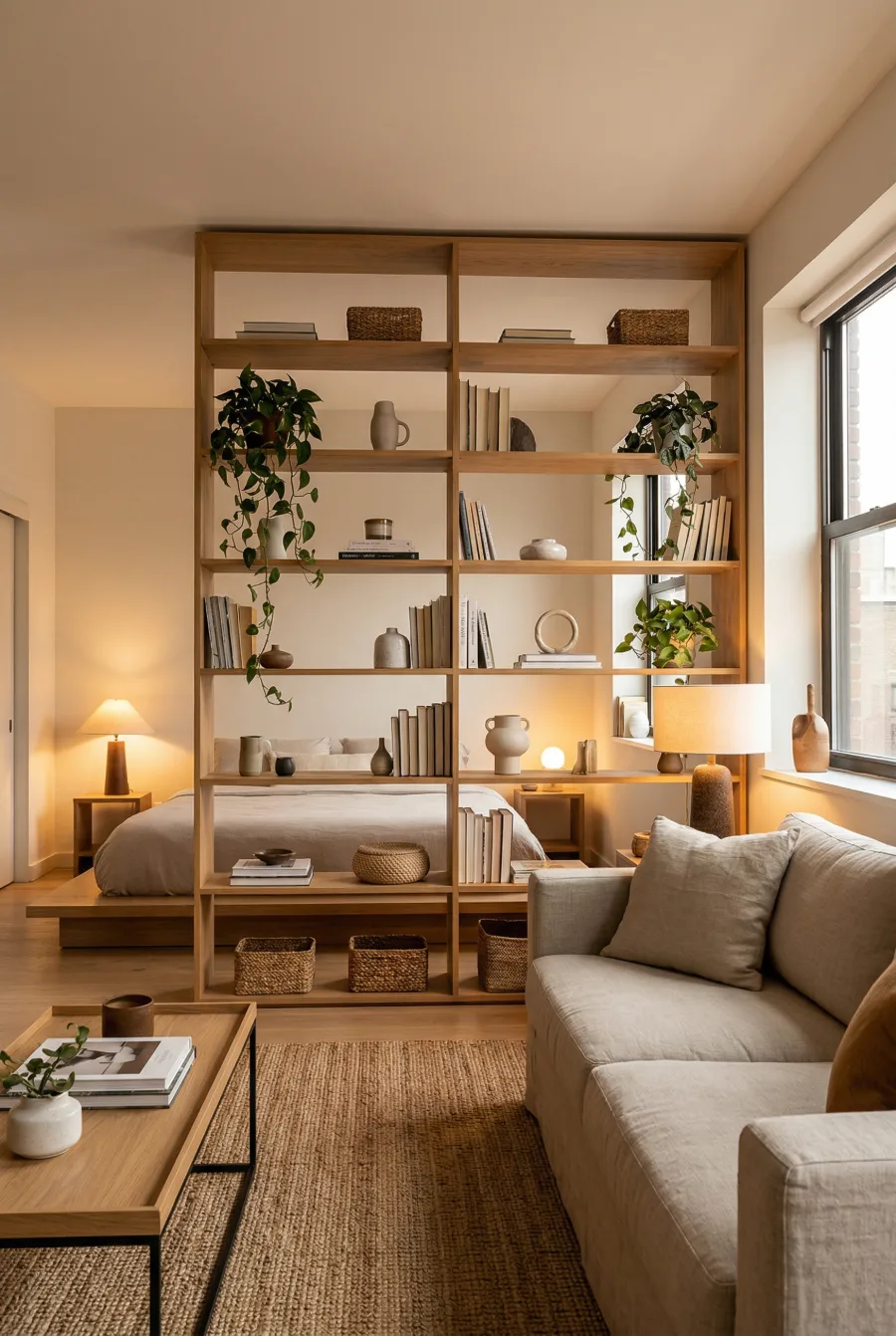
A tall freestanding bookshelf positioned perpendicular to the wall is one of the most functional and permanent-feeling room dividers available in a studio apartment. Unlike a solid partition it does not block light — the open shelving allows daylight to filter through from one zone to another, keeping both sides of the divider feeling bright and airy. The display-facing side — usually toward the living room — shows books, plants, and curated objects. The less-public side facing the sleeping zone can hold more personal items like bedside essentials, reading materials, and small lamps. Double-sided versions with accessible shelving on both faces are the most efficient. For maximum stability, a floor-to-ceiling bookshelf should be anchored to the wall at the top — look for anti-tip kits that include a strap and wall anchor plate. The ideal height for a studio divider bookshelf is approximately six feet — tall enough to create genuine visual separation without reaching the ceiling. Wider bookcases in the 48 to 72 inch range create a more convincing room boundary than narrow ones. If the bookshelf does not fully span the room width, the open space beside it reads as a doorway — which can be a beautiful design choice rather than a shortcoming.
Curtain Room Dividers — Fast, Affordable, and Surprisingly Beautiful
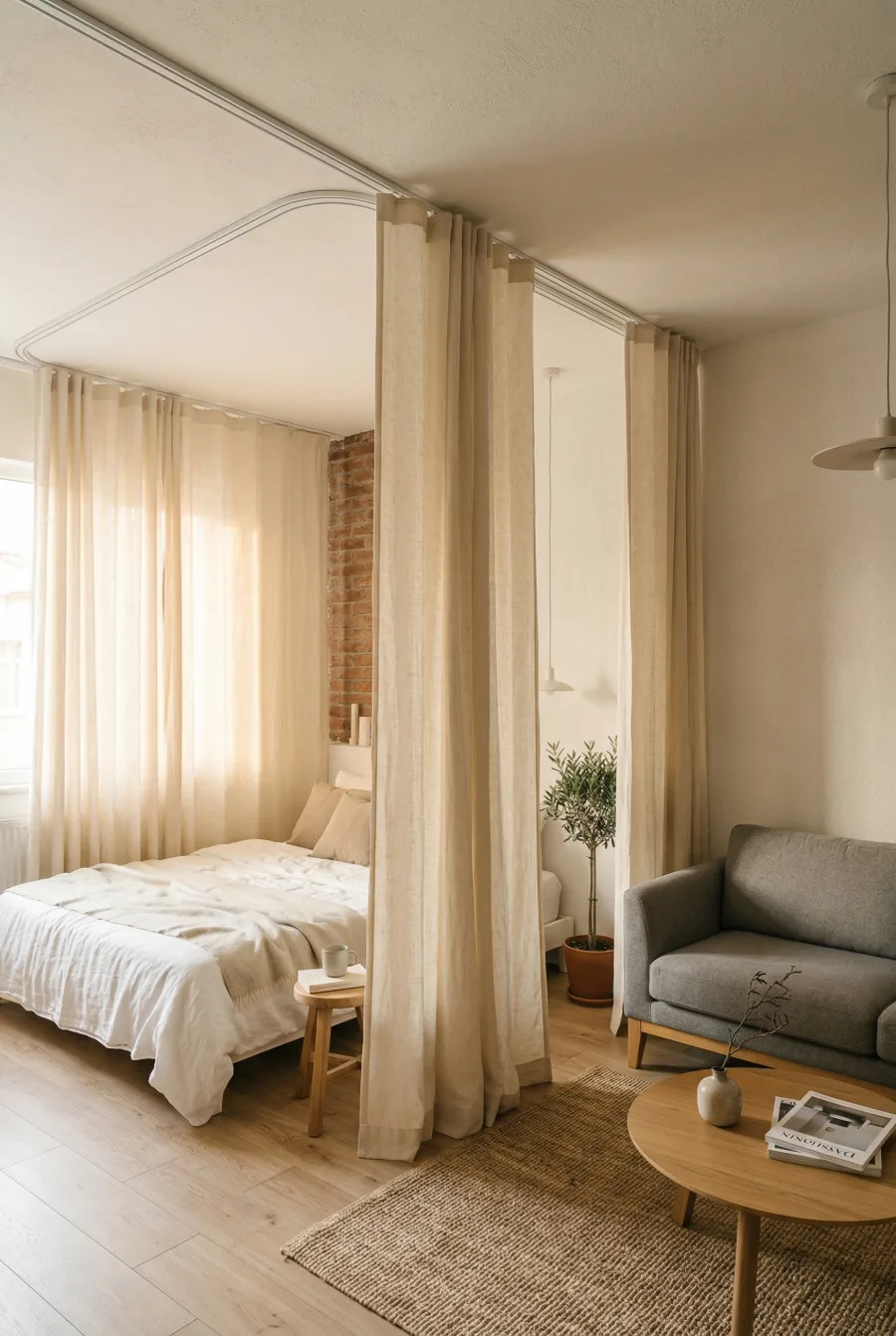
Ceiling-mounted curtain tracks with floor-to-ceiling curtain panels are the most popular room divider solution for studio apartments, and for good reason — they are fast to install, affordable, highly effective, and reversible. When the curtains are drawn, they create a complete visual separation between the sleeping zone and the living area. When open, they stack neatly at one or both sides and allow the full space to function as one room. The key to making curtain dividers look designed rather than improvised is in the fabric weight and ceiling mounting method. Heavyweight linen in a natural or warm neutral tone drapes beautifully and reads as intentional interior design. Cheap polyester curtain panels look exactly like what they are. A ceiling-mounted track — either recessed or surface-mounted — is significantly more polished than a tension rod, though tension rod options exist for renters who cannot mount hardware. The curtain should run from as close to the ceiling as possible all the way to the floor for the full architectural effect. Curtain track systems can be found online for a modest price and installed in an afternoon without professional help, making them one of the best investment-to-impact ratios in the studio apartment zoning category.
Japanese Shoji Screens — Calm, Light, and Timeless
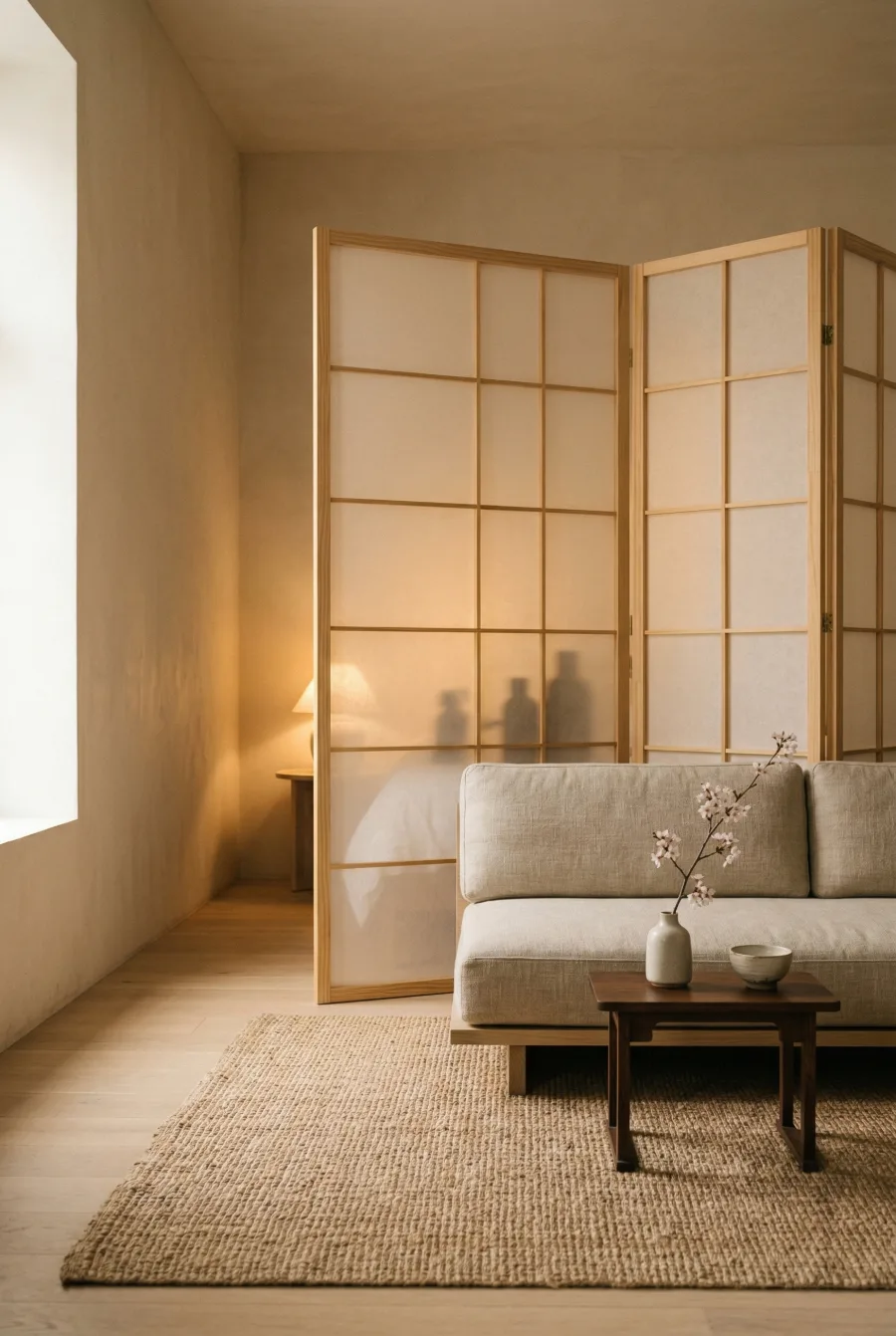
A shoji screen room divider brings a quality of calm and refinement to a studio apartment that no other divider type can replicate. The translucent rice paper or frosted acrylic panel diffuses light rather than blocking it, creating a soft glowing boundary between zones that reads differently at every time of day. In the morning the diffused sunlight creates a luminous warm panel. In the evening the glow of a bedside lamp beyond the screen creates a beautiful silhouette effect that is genuinely atmospheric. Traditional shoji screens use a lightweight timber frame with a grid of horizontal and vertical rails holding translucent washi paper panels. Modern versions use acrylic or polycarbonate instead of paper, which is significantly more durable and easier to clean. Three-panel or four-panel designs in the five to six foot height range are the most practical for studio zoning. The clean geometric lines of shoji screens pair naturally with Japandi, minimalist, and Scandinavian interiors. If you commit to a shoji divider, consider letting it influence the rest of the space — low furniture, natural textures, and a muted palette will make the screen feel like a cohesive design decision rather than an imported element.
The Plant Wall Divider — Living, Breathing, and Air-Purifying
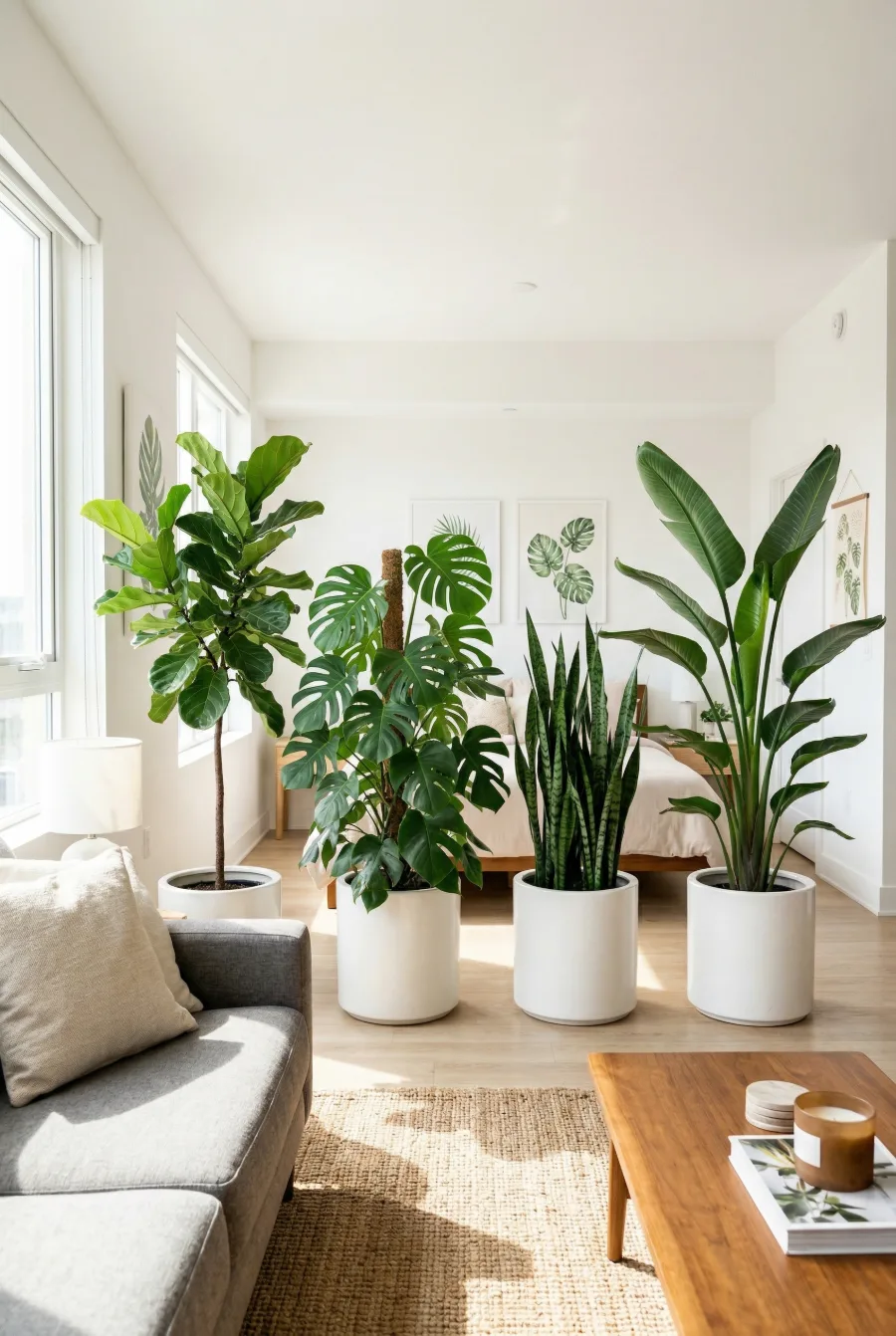
A row of tall indoor plants arranged in a line is the most organic and living room divider concept in this guide — and one of the most beautiful when done well. The key to success is choosing plants that grow tall enough to create a genuine visual boundary at human eye level. Fiddle leaf figs, bird of paradise plants, tall snake plants, and monstera in large ceramic or concrete planters at floor level can reach four to six feet in height and create a lush green partition that doubles as the most interesting visual element in the apartment. Grouping multiple plant varieties at slightly different heights creates a more natural, layered effect than a rigid row of identical plants. Matching planters in ceramic or concrete create cohesion and make the arrangement look curated. The practical requirement of this approach is light — most tall indoor plants need bright indirect light to thrive. Position the plant divider near or perpendicular to a window rather than in a dark interior zone. As an affiliate-friendly category, plant stands, large ceramic planters, and grow lights for low-light apartments are all products with strong purchasing intent from readers interested in this approach.
Open Shelving as a Room Partition — Storage That Earns Its Floor Space
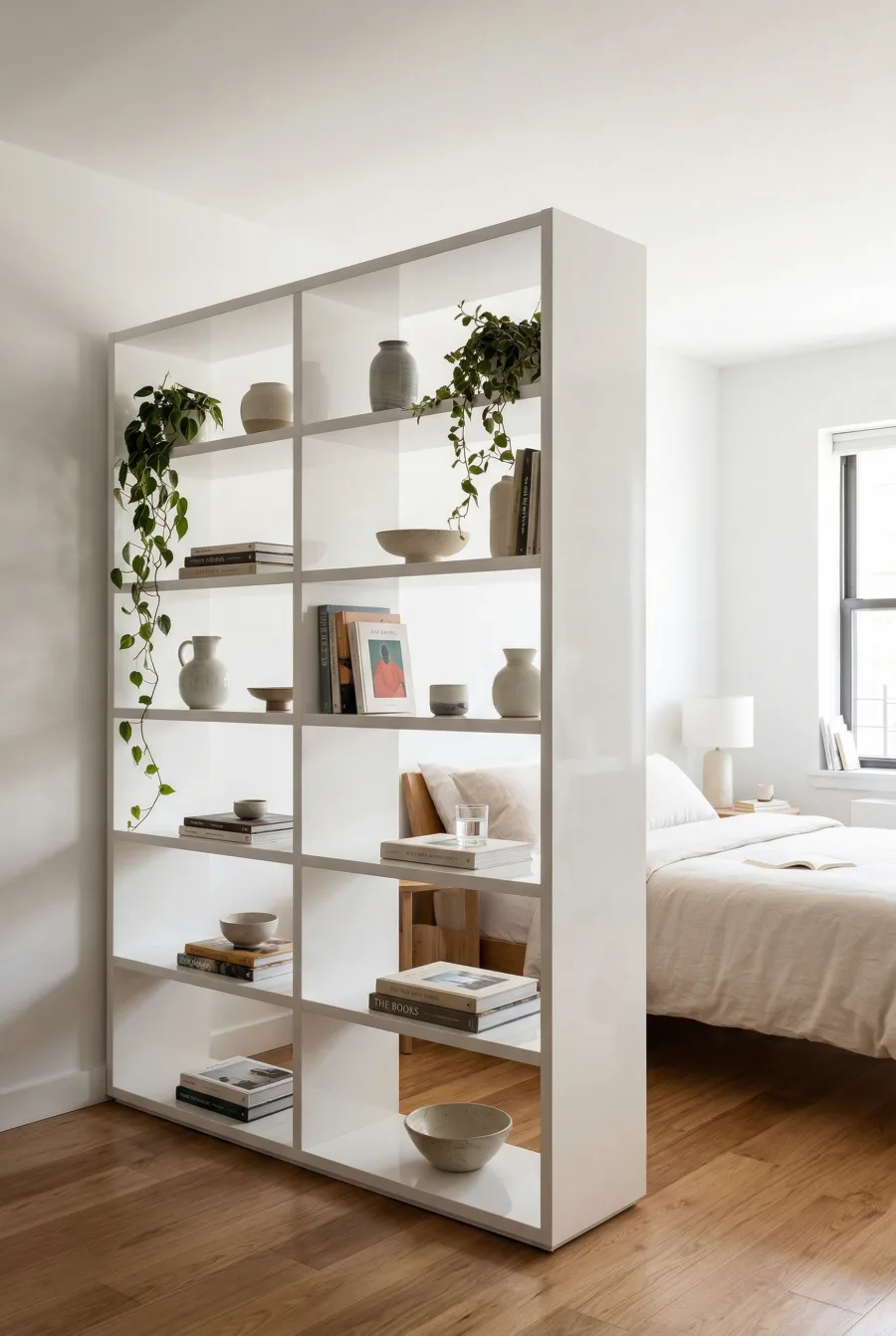
A double-sided open shelving unit — designed to be accessed from both sides — is the most efficient room divider for a studio apartment because it provides storage value on both sides of the boundary it creates. The shelving faces the living zone on one side and the sleeping zone on the other, with items arranged and accessible from whichever side they belong to. The practical layout benefit is that neither zone is disadvantaged by the partition — both sides gain storage rather than losing it. The visual benefit is that the shelving creates a semi-transparent boundary that allows light to pass through while providing clear zone definition. For this configuration to work well, the shelving unit should be stable and well-anchored. Units designed to be freestanding in the middle of a room — rather than against a wall — need to be broader and heavier in their base construction to avoid tipping. The ideal unit for this use is approximately 12 to 18 inches deep with shelves accessible from both sides and a solid base that does not require wall support. Some manufacturers produce units explicitly designed for this room-divider use case — these are worth seeking out rather than adapting a wall-adjacent unit that wasn’t engineered for the application.
Hanging Macrame Room Dividers — Texture, Warmth, and Zone Definition
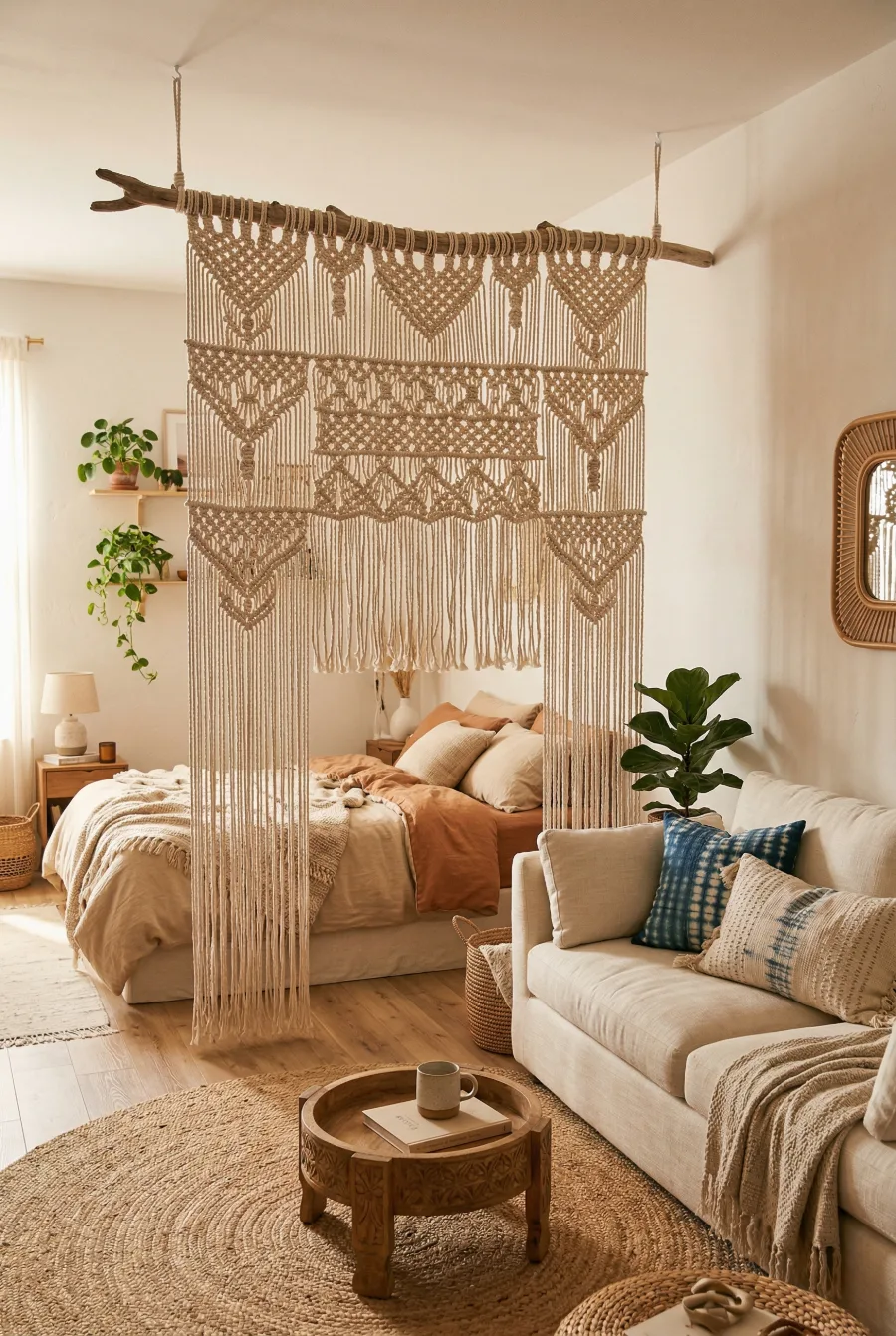
A hanging macrame panel used as a room divider represents the most tactile and warm approach to studio zoning in this guide. Unlike hard or rigid dividers, macrame creates a boundary that is permeable to light and air while providing a strong visual separation that reads as a deliberate design choice. The natural rope texture adds incredible depth and warmth to an apartment interior — something that paint, furniture, and hard dividers struggle to achieve. Macrame room dividers work best in bohemian, Japandi, and warm Scandinavian interior styles where natural materials and handcrafted textures are part of the aesthetic language. For functional zoning, the macrame panel should be wide enough to span the full width of the area you want to divide and tall enough to reach from the ceiling rod to near the floor. Thick cotton macrame in natural undyed ecru or warm off-white reads as the most refined option. Darker or colored macrame can feel costume-y in a residential context. The hardware for hanging is simple — a wooden or metal dowel rod suspended from the ceiling with two hooks — making this one of the easiest room dividers to install. It is also the most portable option: when you move, the entire divider comes down in minutes.
The Pegboard Divider for Home Office Zoning
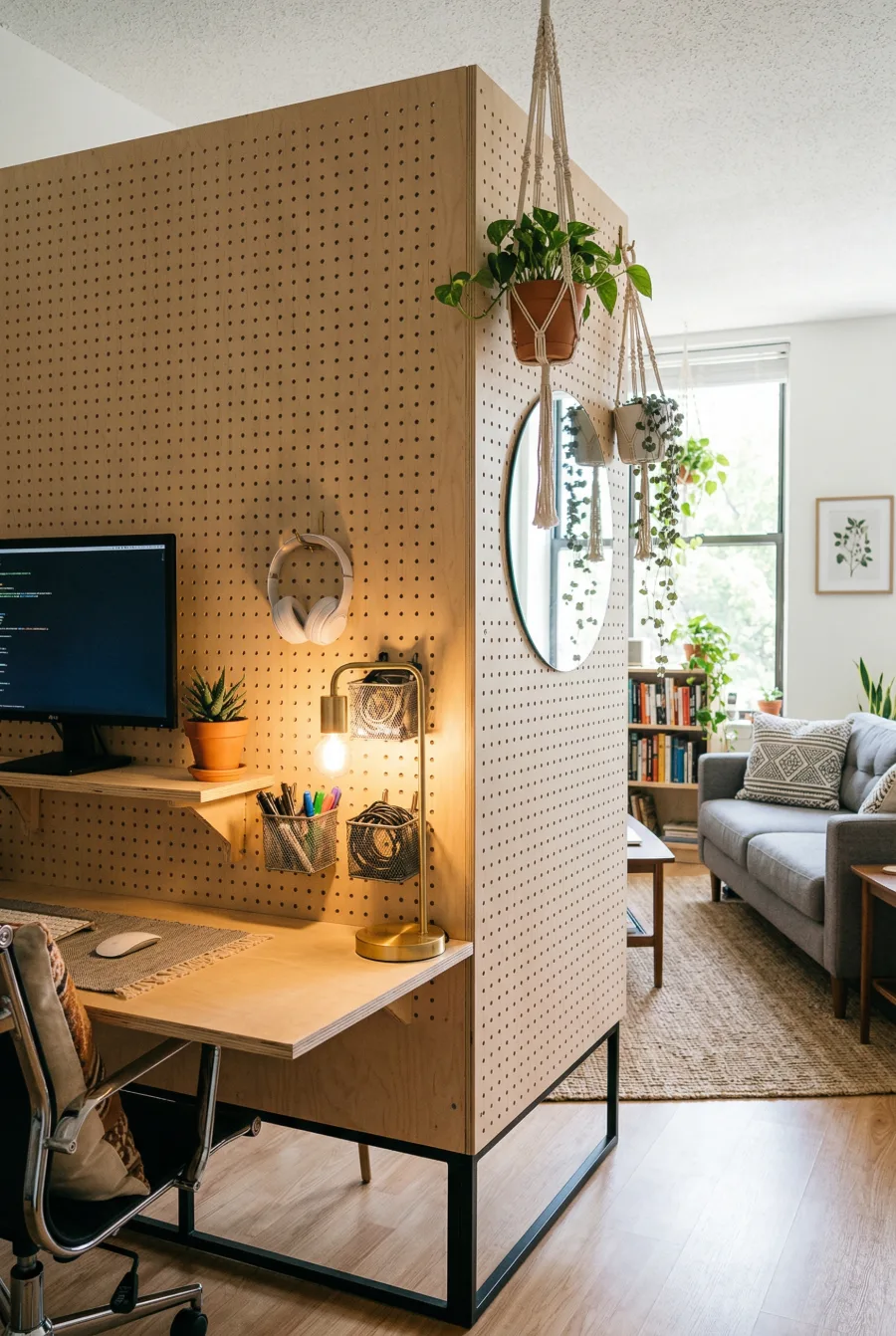
For studio apartment residents who work from home, the home office zone is often the hardest to separate from the rest of the living space — not just visually but psychologically. A pegboard room divider solves this by creating a work-facing side that functions as a full organizational surface and a living-room-facing side that can display plants, art, or a mirror. The pegboard is mounted on a freestanding frame that stands without wall support, making it renter-friendly and repositionable. The work side is where the real magic happens: hooks hold headphones, small shelves support a monitor riser, baskets hold cables and stationery, and a small whiteboard clip holds to-do notes. The entire work zone organizes itself around the divider rather than requiring a desk with drawers or separate storage units. This approach reduces the total floor footprint of the home office zone to just the desk and chair since all supplementary storage lives on the pegboard itself. For those who struggle to mentally disconnect from work at the end of the day, a pegboard that fully encloses the desk side — so the workspace is hidden behind the board when viewed from the sofa — provides a visual off switch that flat walls cannot replicate.
The Rattan Screen — Natural, Warm, and Light-Filtering
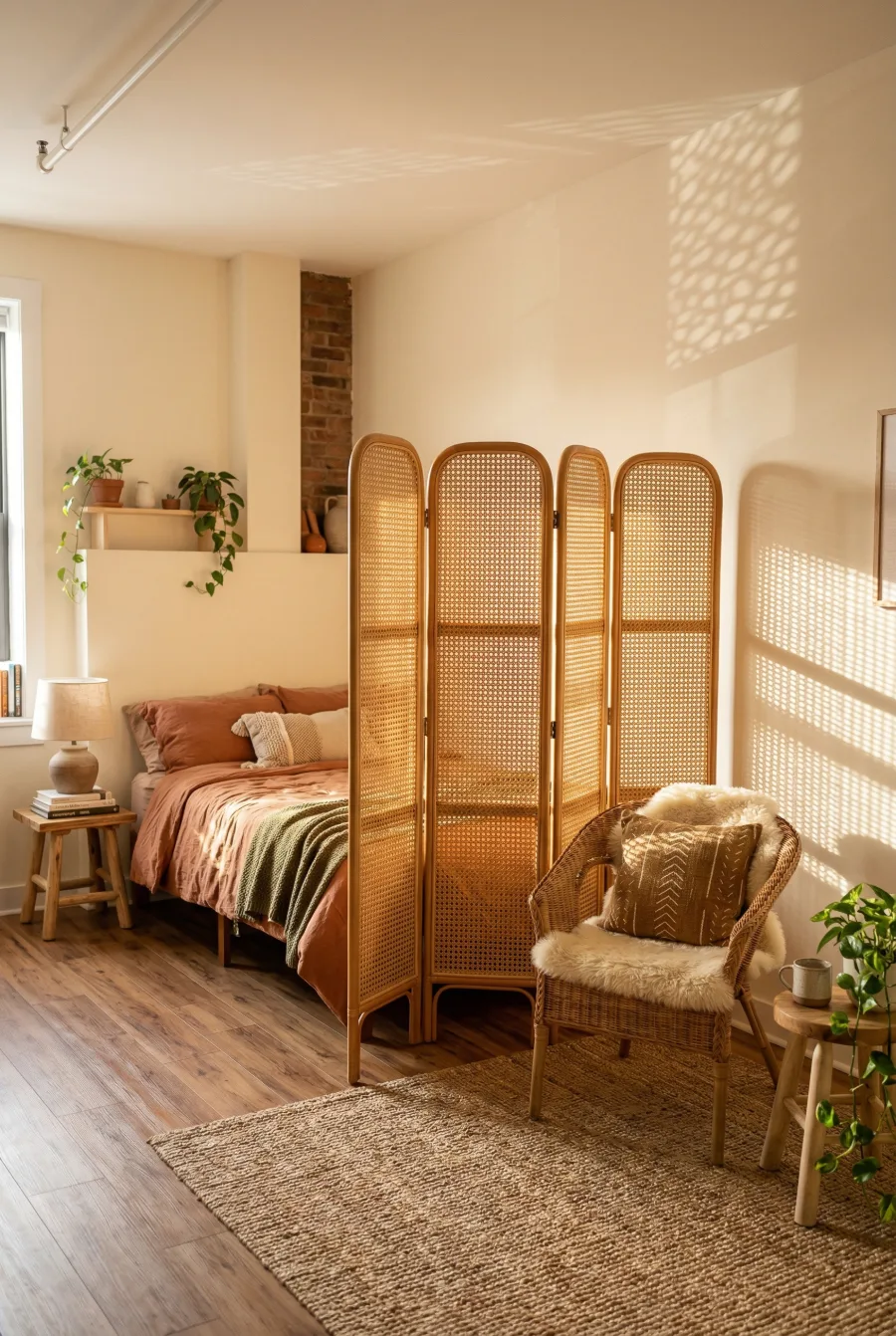
A rattan or woven cane room divider screen is one of the most beautiful and consistently popular choices for studio apartment zoning because it works across a wide range of interior styles. The natural woven texture is warm enough for bohemian and coastal interiors, structured enough for Japandi and minimalist spaces, and neutral enough to not clash with modern or eclectic apartments. The light-filtering quality of rattan weave creates a beautiful dappled shadow effect on the walls as sunlight passes through it — a visual benefit that rigid panels simply cannot offer. Multi-panel folding rattan screens in the four-panel configuration are the most practical for studio zoning — they can be positioned in a straight line, at an angle, or in a slight curve depending on the zone shape you’re trying to define. Natural honey-toned rattan is the most versatile finish. Black-lacquered rattan has a stronger contemporary edge. White-washed versions feel lighter and work well in small apartments where you want the divider to recede visually rather than dominate the space. Rattan screens are among the more affordable room divider options and are widely available from both budget retailers and higher-end home furnishing stores.
The Half-Wall Planter — A Natural Boundary at Hip Height
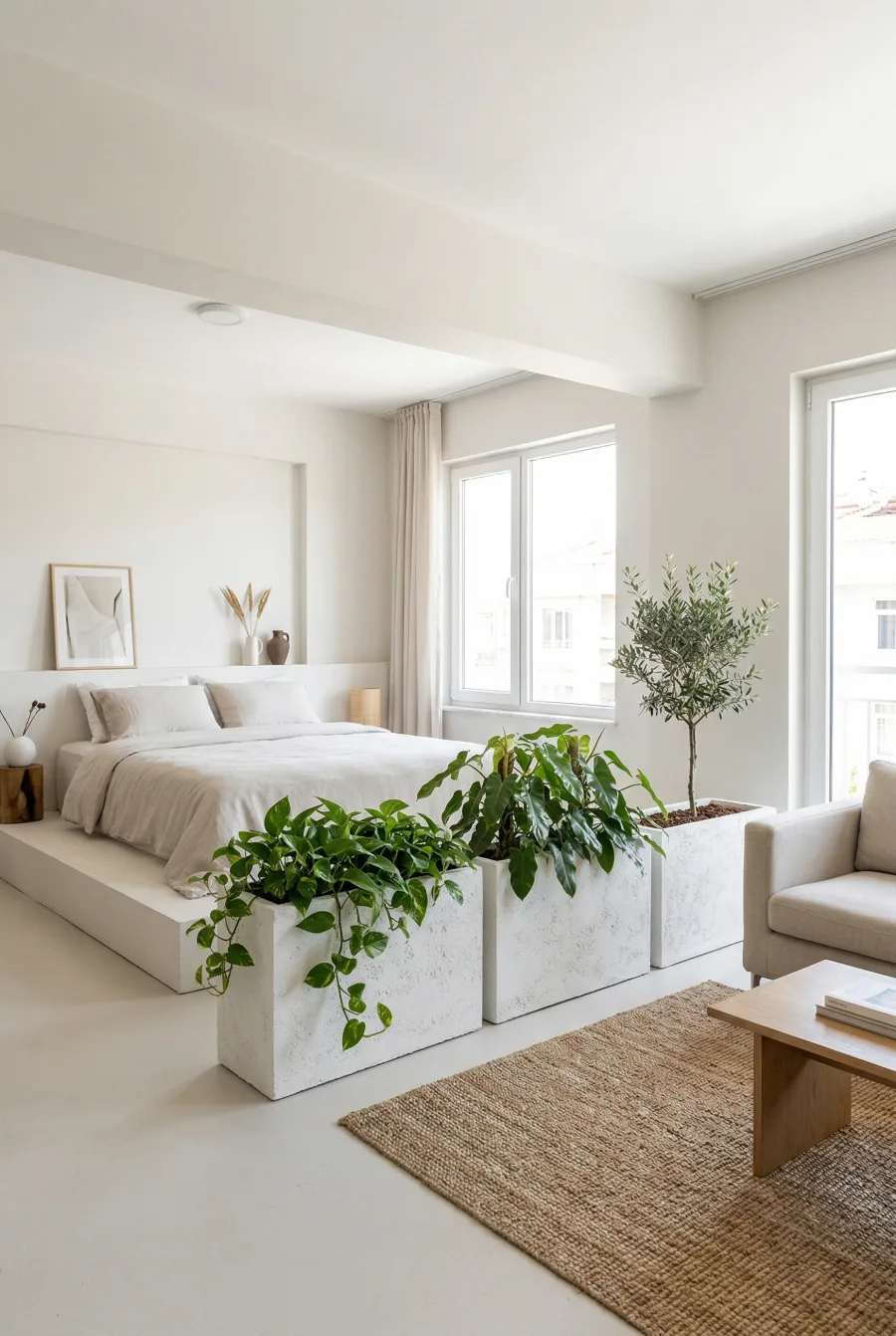
A row of low planter boxes or raised planters at waist height creates the gentlest and most open form of zone separation in a studio apartment. At hip height, the planter boundary defines the floor plan without interrupting the sightlines — you can see over it from anywhere in the apartment, which preserves the sense of openness while still creating distinct zones. This is the ideal divider for studio apartments that are already slightly tight and where a full-height partition would feel oppressive. A series of three matching planters — in ceramic, concrete, or wooden planter boxes — each holding a substantial indoor plant creates a green boundary that is genuinely beautiful and entirely different from any hard-surface divider. The plants at hip height and growing upward to different heights above the planter box create a layered natural edge. Mediterranean and tropical plants — olive trees, ficus, trailing rosemary — work beautifully in this configuration and are available from most plant retailers. The planters themselves are a strong affiliate category: large concrete planters, premium ceramic floor pots, and raised wooden planter boxes with drainage are all in significant demand from the studio apartment interior design audience.
Ceiling Curtain Tracks for a Full Bed Enclosure
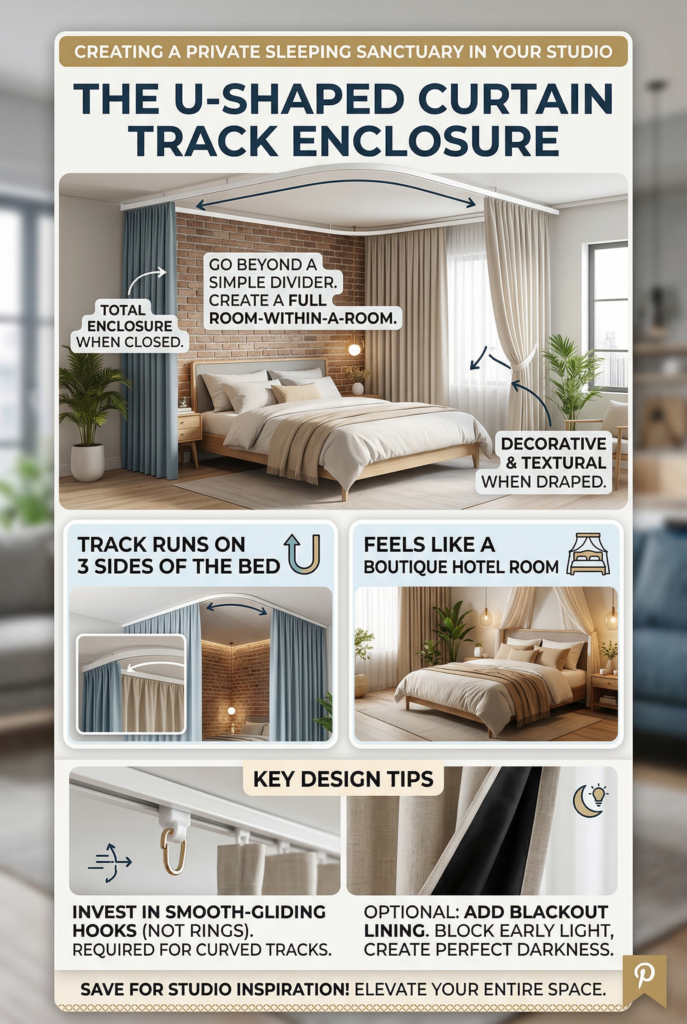
Taking the ceiling curtain concept further than a simple divider, a U-shaped or three-sided curtain track installed above the sleeping zone creates a full bed enclosure — a private sleeping sanctuary within the studio apartment that feels more like a boutique hotel room than a cordoned-off corner. The track runs on three sides of the bed, with curtains that can be drawn completely closed to create a room within a room or left open in a relaxed draped arrangement that adds texture and warmth. This approach is particularly effective for studio apartments where the bed is positioned against a wall — the curtain track on the open three sides creates the impression of a purposeful sleeping alcove. The investment in a quality ceiling curtain track system is worthwhile here since it will be opened and closed daily. Look for systems with smooth-gliding curtain hooks rather than rings, as ring-and-rod systems are not appropriate for curved or U-shaped track configurations. Blackout lining added to standard linen curtain panels is an optional upgrade that improves the sleeping environment significantly — blocking early morning light and creating genuine darkness for better sleep quality.
The Barn Door — Sliding Style That Disappears Into the Wall
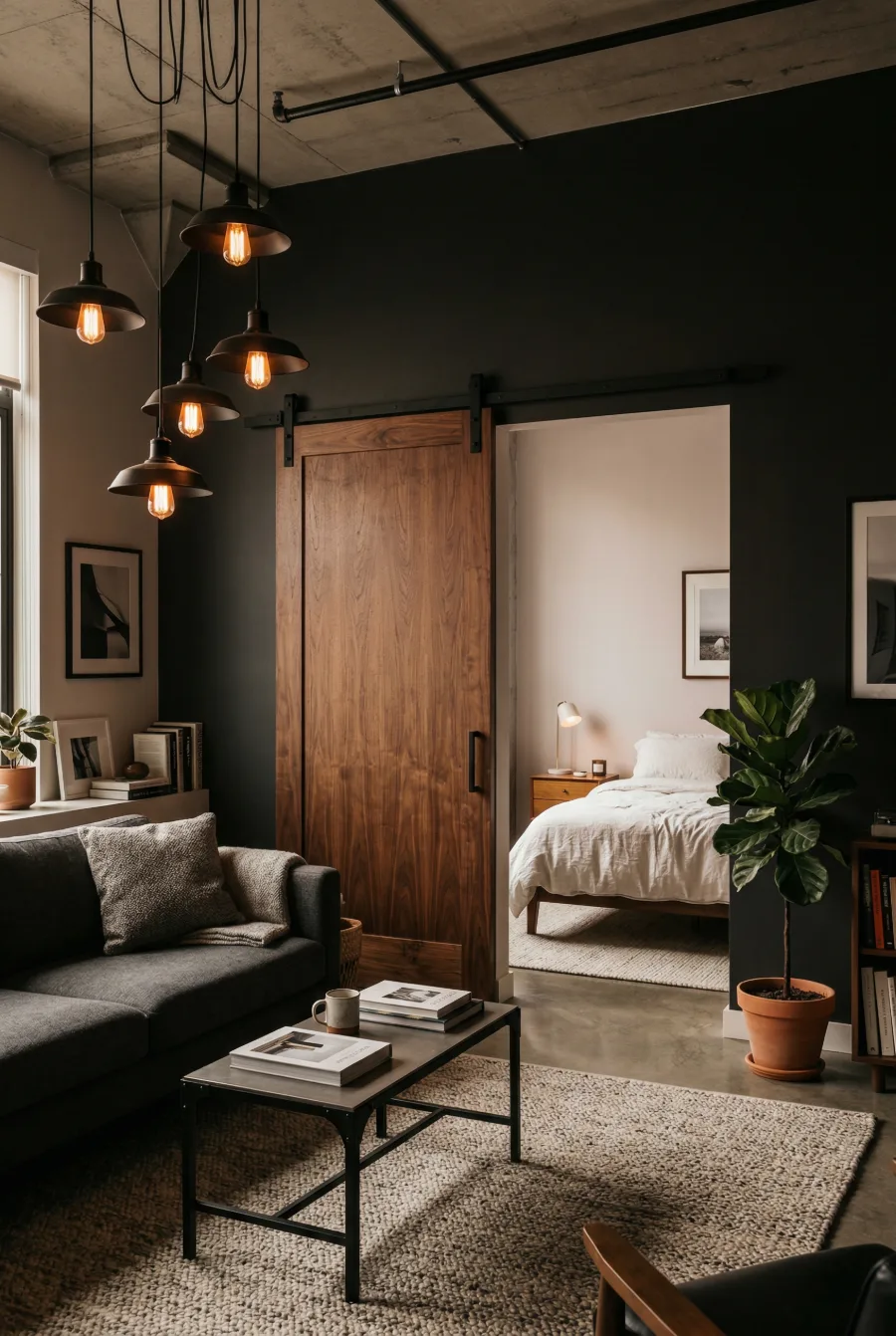
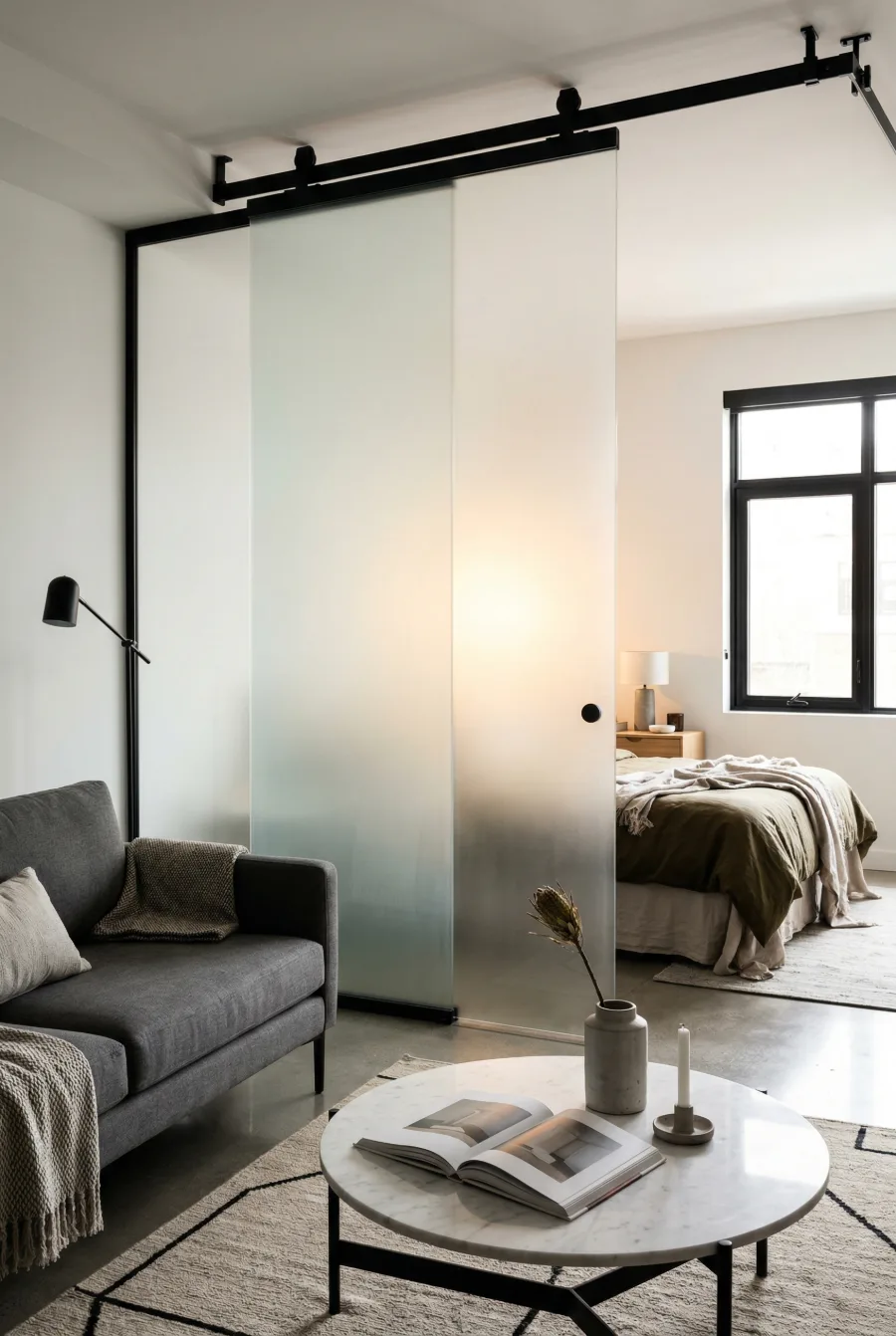
A sliding barn door on a ceiling-mounted rail brings an element of interior architecture to a studio apartment that most other dividers cannot match. When the barn door is open, it slides fully to the side and becomes a feature wall element in its own right — a beautiful panel of wood or glass that decorates rather than hides. When drawn closed, it creates a solid and visually substantial room boundary that provides genuine privacy and sound attenuation. Unlike a swinging door, a barn door takes no floor clearance — it slides horizontally and never obstructs movement through the space. The most popular finishes for studio apartment barn doors are solid wood in natural or dark-stained finishes, frosted glass, and mirror. Each has a distinct character: wood is warm and residential, frosted glass maintains light flow while providing privacy, and mirror adds the visual expansion quality of a large reflective surface. Installation requires a solid wall anchor for the rail system — a professional installation is recommended for the ceiling rail mounting to ensure the door hardware is securely supported. For renters, some landlords approve barn door installations if the walls are restored on move-out, making this a negotiable upgrade rather than an automatic no.
Vertical Gardens as Room Dividers
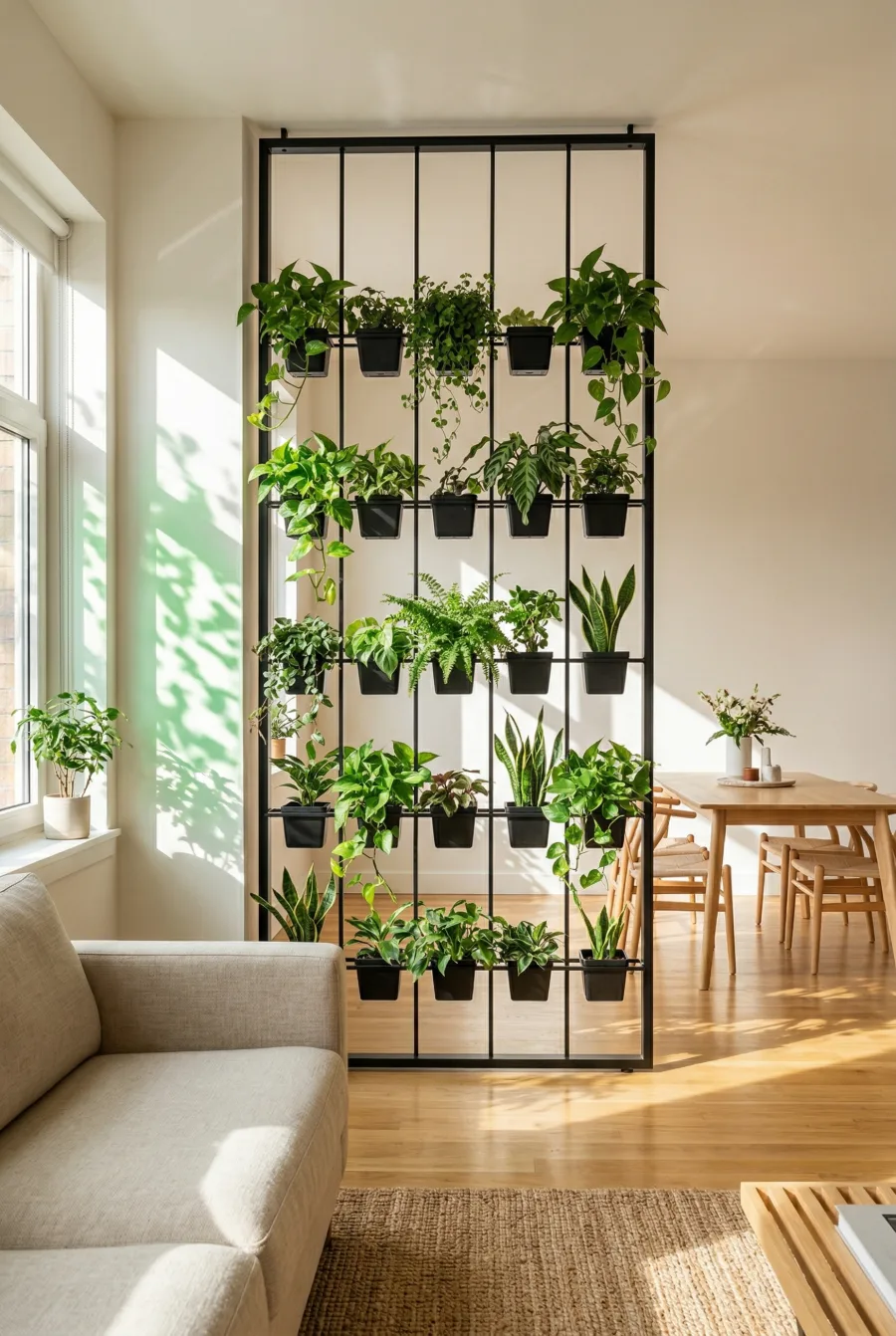
A freestanding vertical garden frame used as a room divider takes the plant divider concept to its most dramatic conclusion. A floor-to-near-ceiling metal grid structure with integrated planter pockets or clip-on pots creates a living wall of greenery that divides the studio apartment into zones while functioning as its most impressive visual element. From a distance, the vertical garden reads as a wall of foliage. Up close, the individual plants — trailing pothos, ferns, small-leafed philodendrons — create an intimate and layered texture that is endlessly interesting. The primary practical consideration for a vertical garden divider is watering — trailing plants and ferns need consistent moisture, which means either a disciplined manual watering routine or a drip irrigation system connected to the planters. Self-watering planter inserts that hold a reservoir of water and wick moisture to the roots on demand reduce this maintenance burden significantly. Light is the other critical requirement — most vertical garden plants need bright indirect light to thrive, which usually means positioning the frame near a window rather than in the interior of a deep apartment. As a category, vertical garden frames, self-watering planters, and trailing plants are a strong affiliate opportunity with high engagement from the home decor audience.
Mirror Panels — Divide and Expand Simultaneously
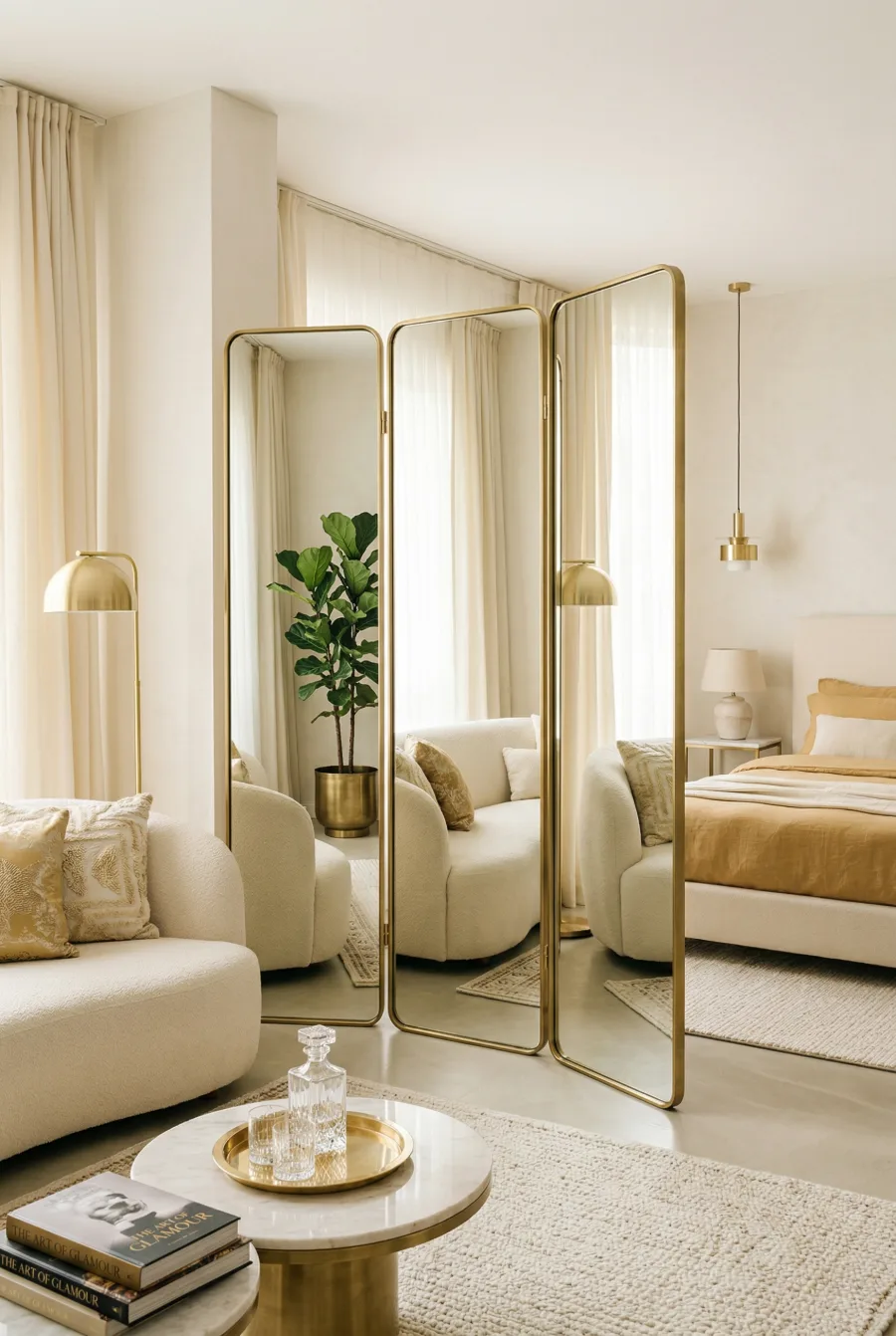
A mirrored room divider panel is the only divider in this guide that simultaneously creates zone separation and makes the apartment feel larger. The mirrored surface reflects the opposite wall, doubling the perceived depth of the room and creating a sense of expansion that is the opposite effect of most divider types. A three-panel freestanding mirror screen in slim brass or black metal frames positioned between the living and sleeping zones adds glamour and function in equal measure. The reflective surface also bounces light — from windows, from lamps, from the glow of morning — around both sides of the divider, which keeps smaller studio apartments feeling bright even when the floor plan is subdivided. For this reason, mirror panel dividers are particularly effective in north-facing or naturally dim apartments where every photon of light needs to be maximized. The practical limitation of mirrored dividers is their weight and fragility — they require careful positioning and should not be used in high-traffic areas where they might be knocked or bumped. Anti-tip straps that anchor the freestanding base to the wall behind it provide essential stability. Quality mirror panels in properly engineered frames are worth the investment since the alternative — cheap frames with thin mirror glass — tend to distort reflections and age poorly.
Using a Wardrobe as a Room Divider
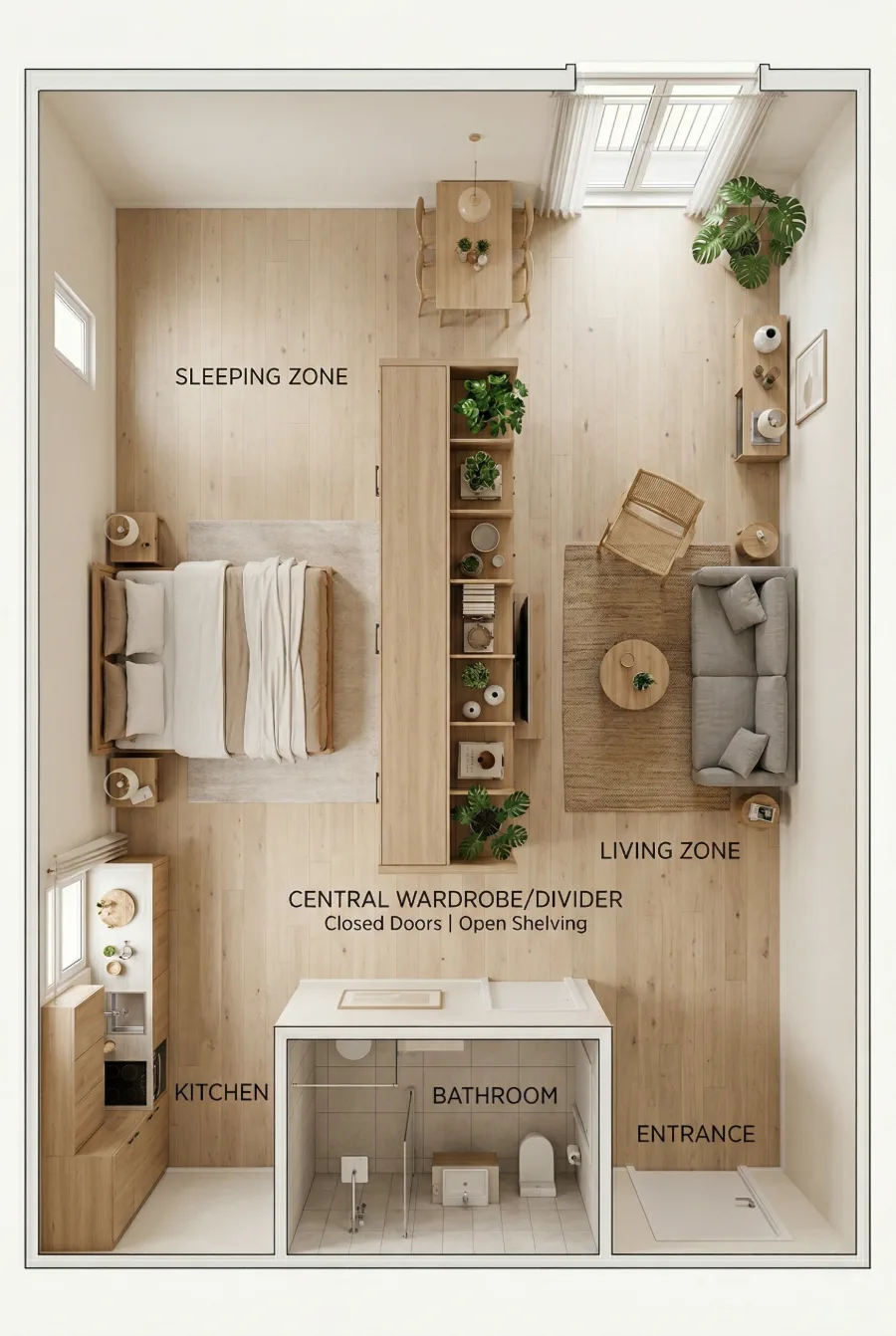
One of the most practical and underused room divider strategies in a studio apartment is positioning a freestanding wardrobe perpendicular to the longest wall — using it as both a clothing storage solution and a zone separator simultaneously. The wardrobe face with the doors opens toward the sleeping zone for clothing storage access. The back of the wardrobe or, better yet, an open shelving back panel faces the living zone and provides book or decor display space. This approach requires no additional floor space beyond what the wardrobe already occupies since the piece would be needed for clothing storage regardless. The main consideration is the wardrobe depth — most standard wardrobes are 24 inches deep, which creates a substantial boundary between zones. Make sure the wardrobe’s position allows enough clearance on both sides for comfortable movement. A wardrobe used as a room divider should be secured to the adjacent wall with an anti-tip strap for safety, as a full wardrobe is extremely heavy when loaded and positioned away from a wall. Back-panel options that include open cubes rather than a solid panel are available from modular wardrobe systems and are the most functional for a divider application.
Accordion Folding Screens — Maximum Flexibility in One Panel
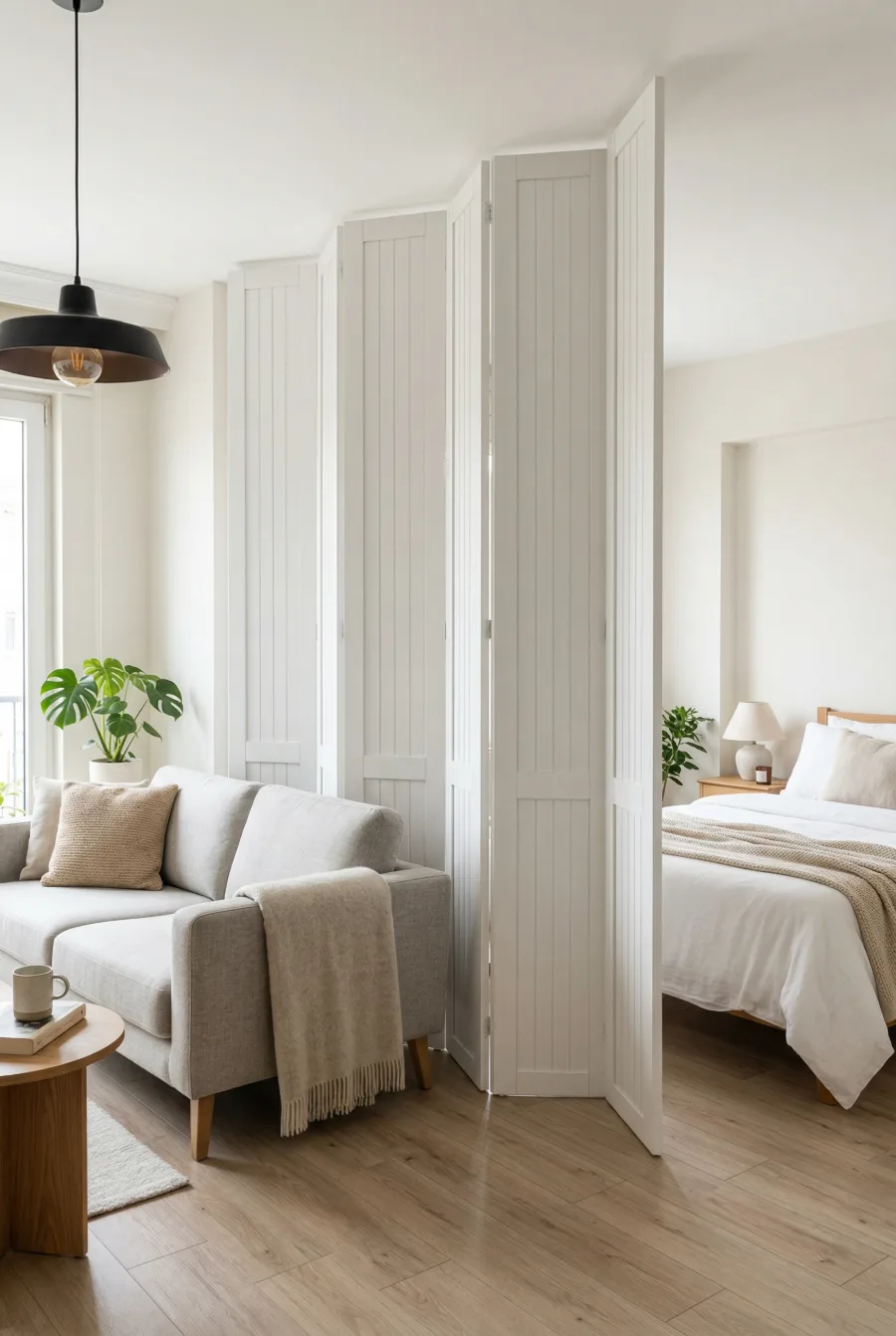
An accordion folding screen is the most flexible room divider option in this guide because it can be configured along an infinite spectrum from fully open to fully closed. Fully extended, it spans the width of a room and creates a solid visual boundary. Partially folded, it creates a soft angled partition that suggests separation without enforcing it. Fully folded, it collapses into a package that is a few inches wide and can stand vertically against any wall. This flexibility makes accordion screens particularly valuable in studio apartments where the zoning needs change throughout the day — open for morning yoga, partially closed for afternoon work calls, fully closed for evening sleeping privacy. The material of the accordion screen panels determines its character: solid painted wood panels are the most architectural and durable, woven rush or rattan insert panels are the warmest and most natural-feeling, and paper or fabric insert panels are the most affordable but least durable. Quality accordion screens have piano hinges at each panel join that fold smoothly in both directions and hold their position at any angle. Screens with six or more panels give the most configuration flexibility, while four-panel versions are adequate for spanning typical studio apartment widths.
The Curtain Canopy Bed Nook — A Sanctuary Within a Studio
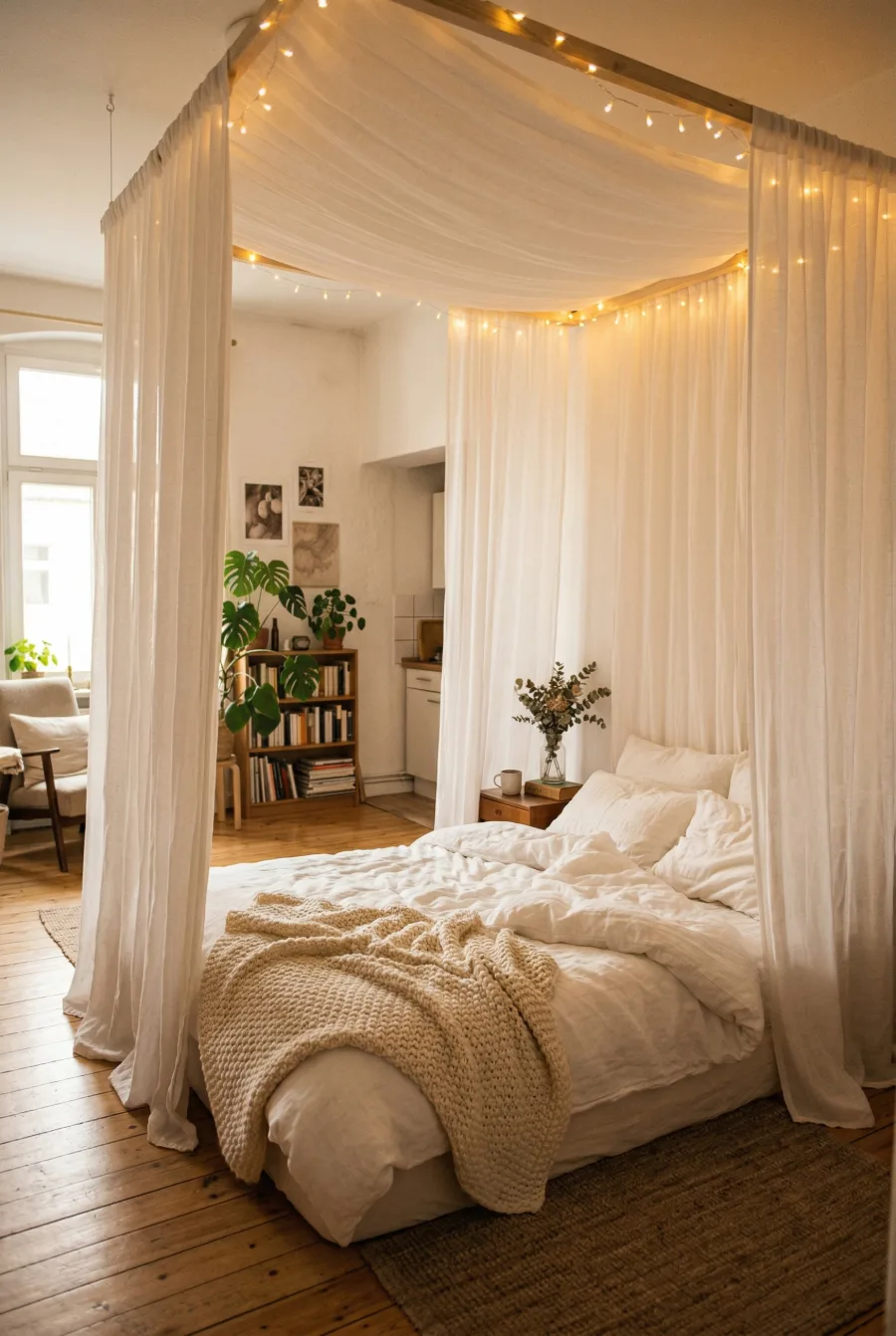
Beyond simple zone separation, the curtain canopy bed nook approach creates something even more valuable in a studio apartment — a genuine sense of sanctuary within the sleeping zone. By surrounding the bed on three or four sides with floor-to-ceiling curtains hung from a ceiling-mounted canopy frame or from individual hooks, you create an enclosure that feels utterly distinct from the rest of the apartment. Inside the canopy the space is private, intimate, and cozy regardless of what is happening outside it. This psychological effect — the sense of being in your own space within a shared or multifunctional room — is deeply restorative and can significantly improve sleep quality. The canopy frame can be as simple as a ceiling-mounted hook at each corner of the bed from which curtain rods or wooden dowels are suspended, or as refined as a four-poster bed frame with integrated curtain channels on all four sides. Sheer white or ivory linen creates the most luminous and airy canopy. Heavier linen or velvet creates a more cocoon-like and soundproof effect. String lights or a small pendant hung inside the canopy add warmth and make the enclosure feel like a designed element rather than a partition.
Geometric Metal Frame Dividers — Art and Architecture in One
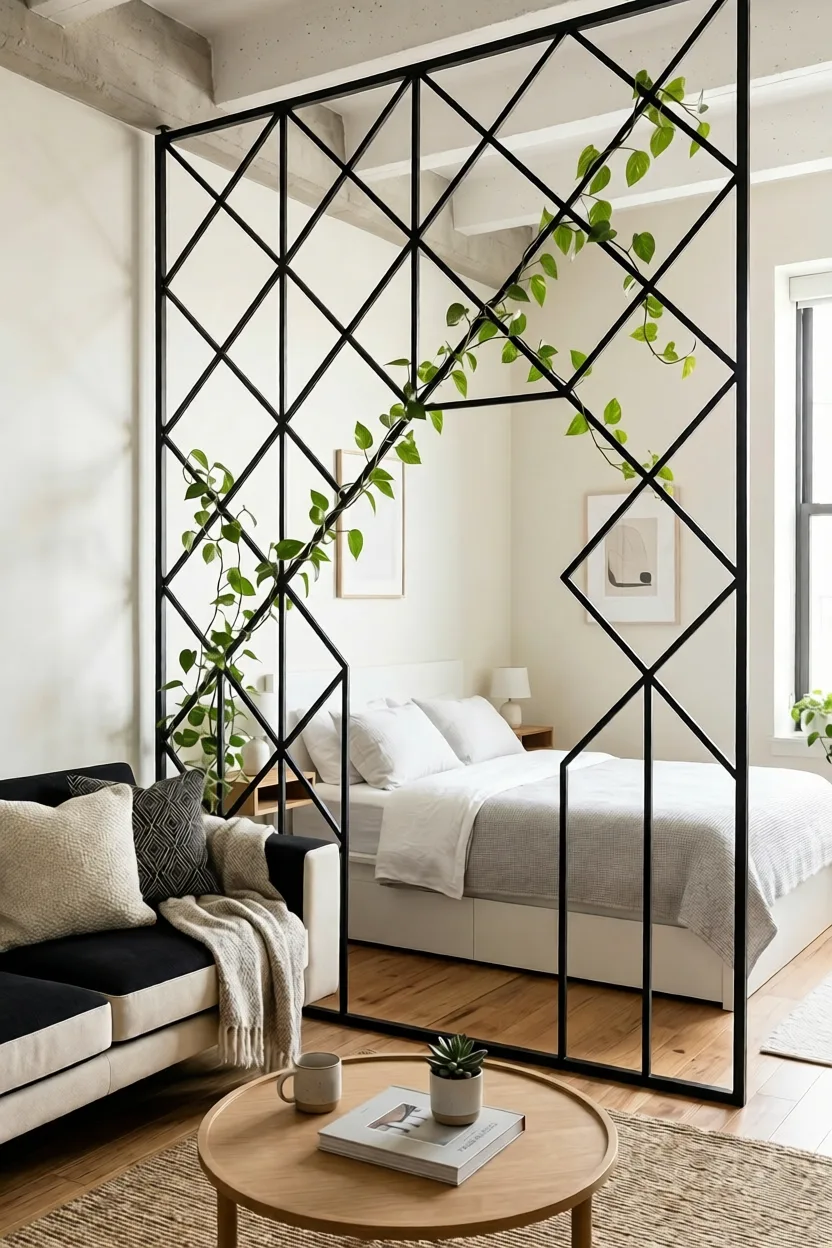
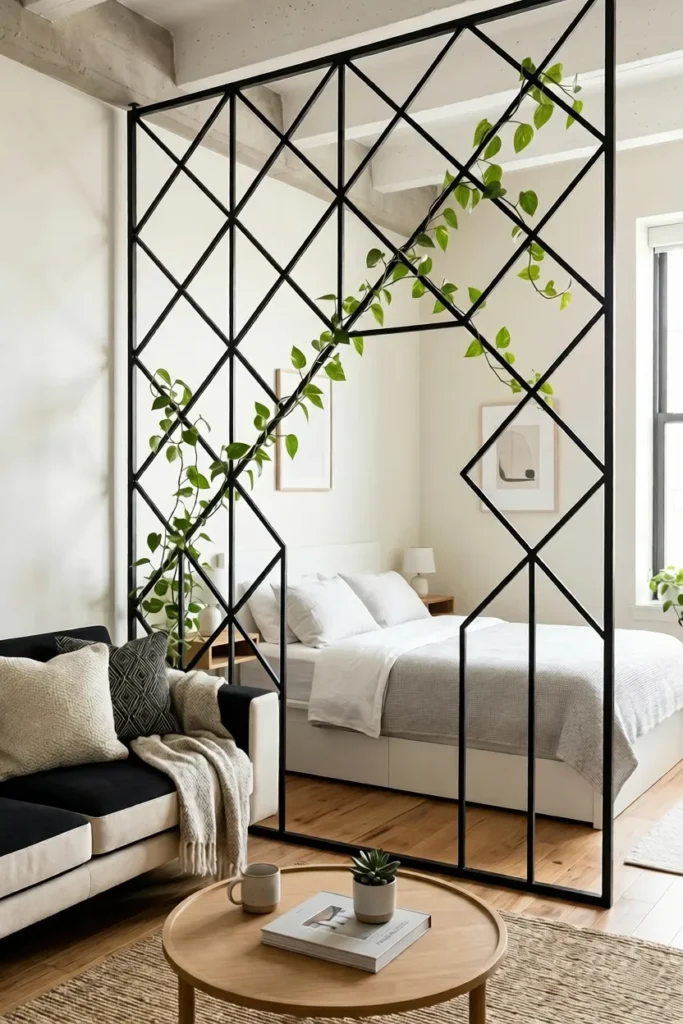
A geometric open metal frame room divider is the most sculptural option in the room divider category — a piece that functions as both art and architecture simultaneously. The open metal grid creates a visual boundary between zones without blocking light or air movement. The geometric pattern — whether it is a simple square grid, a diamond lattice, or a more complex hexagonal design — adds a strong graphic element to the studio apartment interior that becomes one of the room’s defining visual features. Matte black steel frames are the most popular finish for this type of divider because they read as bold and deliberate against light walls. Brass and bronze finishes create a warmer, more glamorous effect that pairs well with velvet and linen furnishings. Natural or weathered steel has an industrial authenticity that works in loft-style apartments. The divider can be used on its own as a graphic statement, or supplemented over time with trailing plants woven through the grid structure, creating an increasingly lush botanical effect as the plants grow. Floor-mounting systems — flat feet that stabilize the frame on any surface without wall anchoring — make this renter-friendly. Look for frames engineered from steel tubing rather than thin sheet metal for stability under the weight of plants.
Floating Shelf Partitions — Minimal, Airy, and Double-Sided
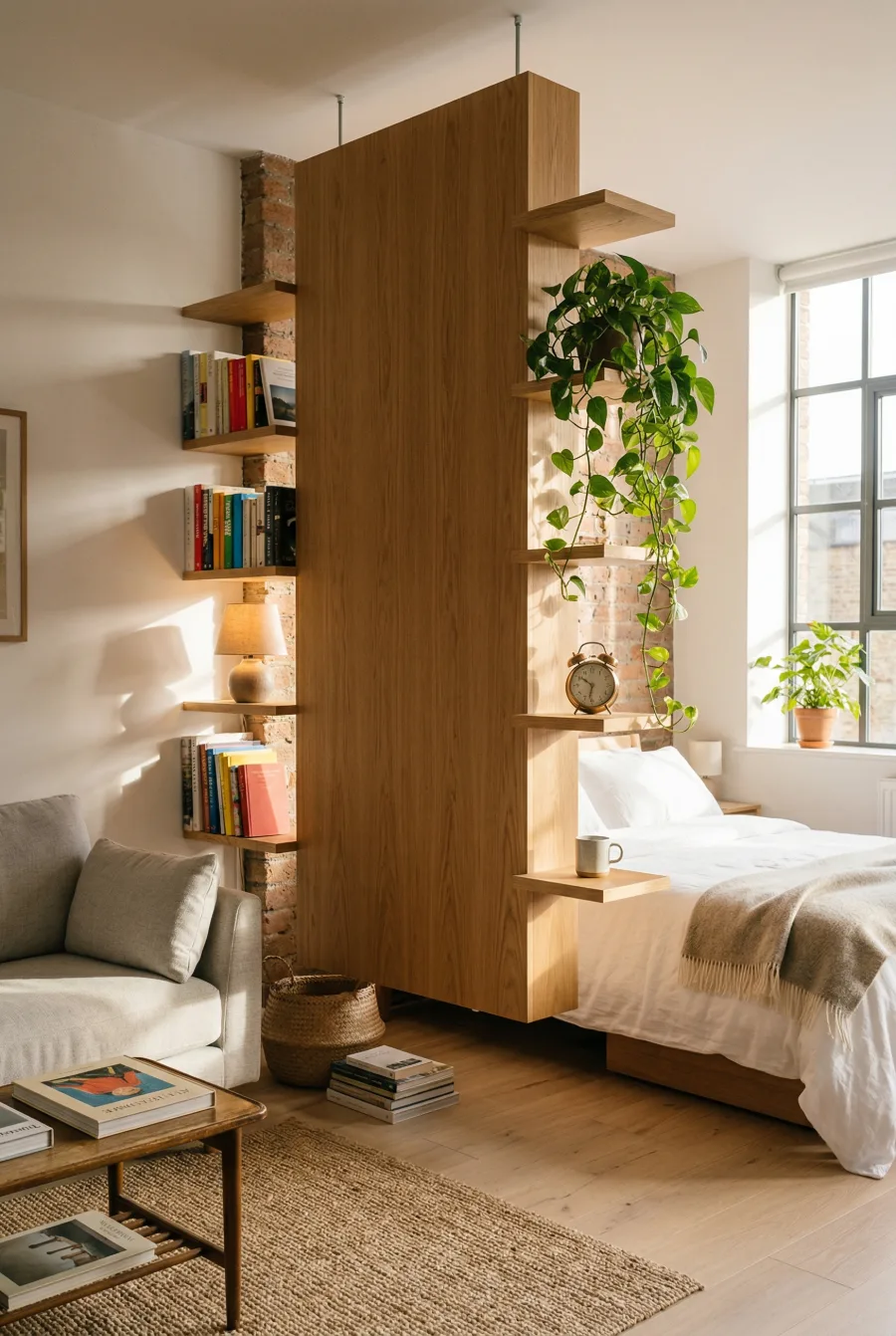
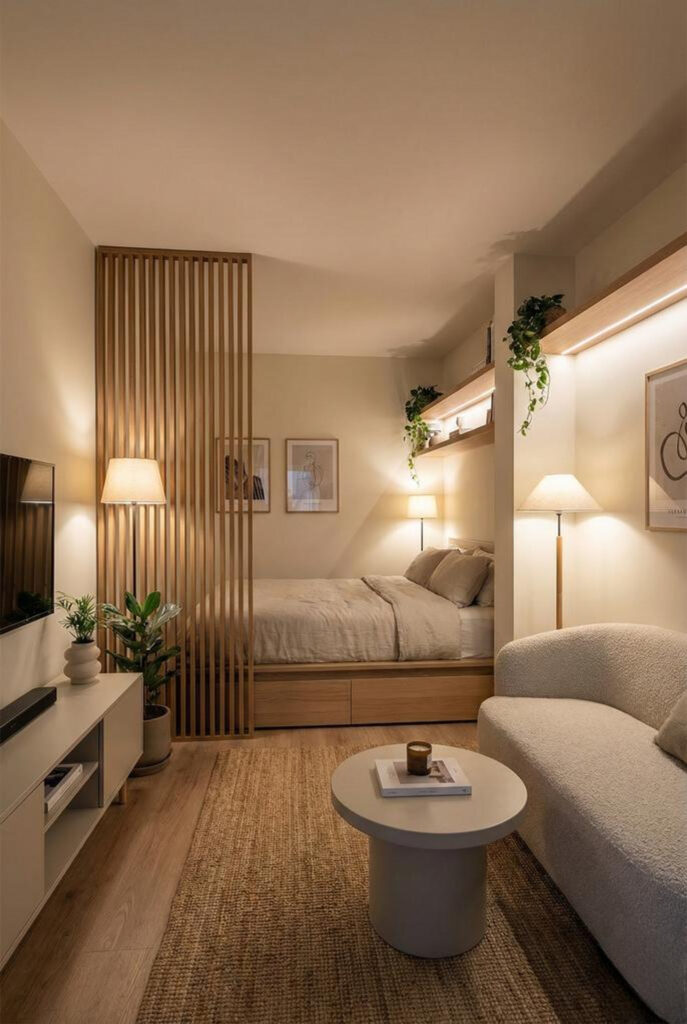
A floating shelf partition — a tall vertical panel with cantilevered shelves on both sides — is the most minimal and least visually intrusive approach to studio apartment zoning in this guide. Because the shelves project from a slim vertical panel rather than from a floor-standing cabinet, the floor beneath is entirely clear. This open floor plane makes the apartment feel larger rather than smaller despite the addition of a zone divider. The shelves at different heights on each side of the panel create storage for both zones — books and decor on the living room side, bedside items and lamps on the sleeping side. The visual permeability at ground level — where no furniture exists — allows light to travel freely from one end of the apartment to the other, which is especially important in narrow studio floor plans where blocking floor-level light would make the space feel tunnel-like. This type of partition typically requires wall mounting at the top for stability since the floor-clearing design means there is no weighted base. A professional installation with proper wall anchoring is recommended for any floating partition that reaches above five feet in height.
Tension Rod Curtain Dividers — The Renter’s Best Friend
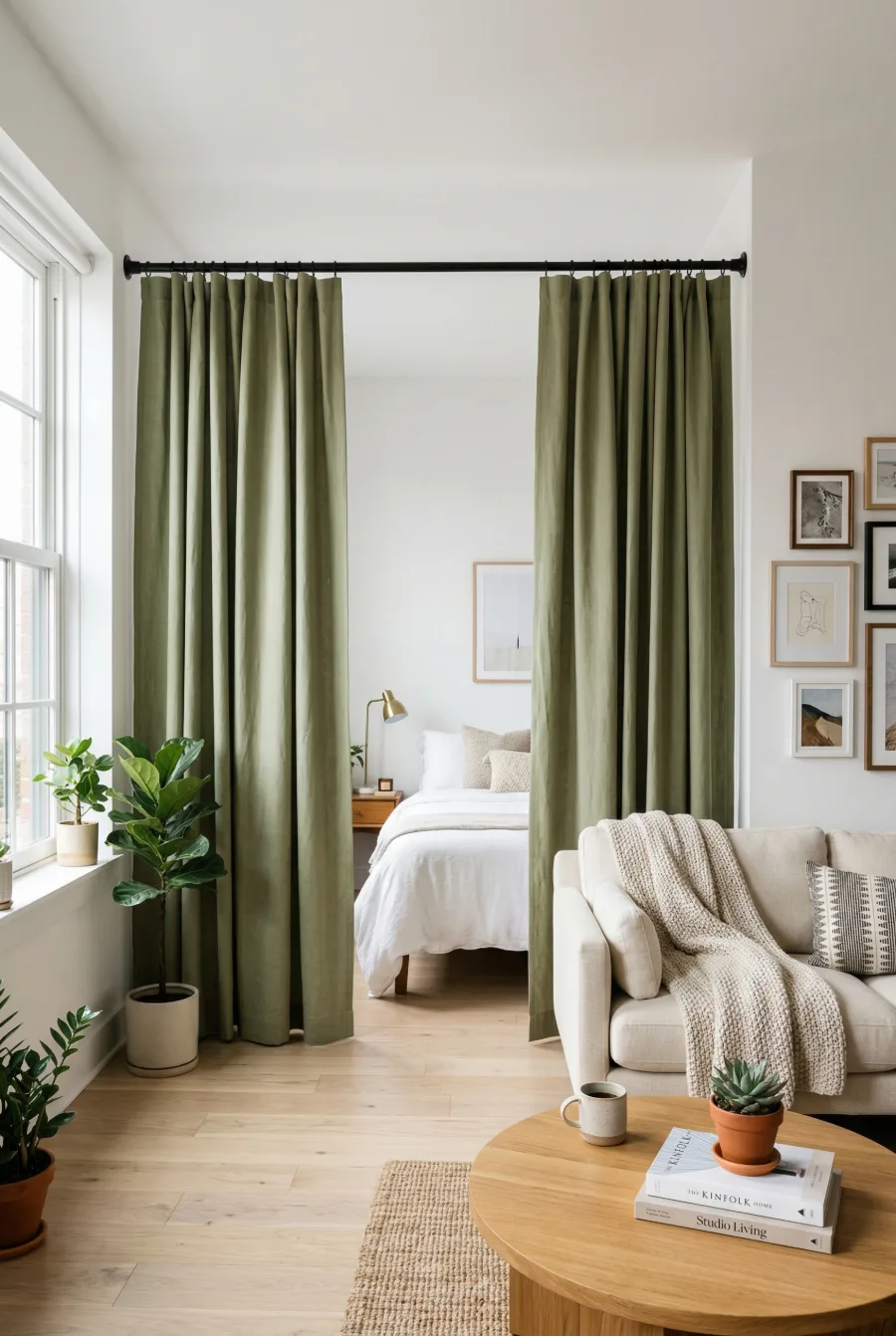
The tension rod curtain divider is the ideal starting point for anyone new to studio apartment zoning who wants to test the concept before committing to a permanent or semi-permanent installation. Heavy-duty tension rods — the type rated for wide spans and heavy curtain weight — press between two walls or between a wall and a structural column using spring pressure, requiring zero hardware and leaving zero damage when removed. Paired with heavyweight linen or cotton curtain panels that reach from the rod to the floor, a tension rod divider creates a surprisingly convincing bedroom zone in a studio apartment. The key to making this approach look designed rather than improvised is in the curtain quality and length — floor-length curtains in a substantial fabric with minimal wrinkle will always read as intentional. Cheap polyester curtains that bunch, wrinkle, and sag will always read as a workaround. For renters who need a zero-damage room divider solution immediately, this is the most accessible and fastest option available. And as a first step toward experimenting with zone separation, it provides a low-commitment way to discover whether having a defined sleeping area changes how you feel about and use your studio apartment — which it almost always does, profoundly and immediately.