Small Apartment Kitchen Organization Ideas That Double Your Storage Without Touching a Wall
Category: Space-Saving Ideas | Read time: 11 min
A small apartment kitchen is one of the most consistently frustrating spaces in compact living — not because it lacks square footage, but because almost every kitchen in a small apartment is organized in exactly the same generic way it came from the builder, with no consideration for how a real person actually cooks, stores, and moves through the space. The result is a kitchen where the counter is permanently covered with things that have no home, the cabinets are stuffed with items that fall out when opened, and cooking feels like an exercise in managing chaos rather than creating something. The kitchen organization ideas in this guide don’t require renovation, don’t require a landlord’s permission, and don’t require significant investment. They are targeted, specific, product-based solutions that address each storage problem in a small apartment kitchen systematically — from the wall space to the under-sink cabinet to the back of every door. Implement three or four of these and you will have a fundamentally different kitchen. Implement all of them and you will have a kitchen that works as well as one three times the size.
Magnetic Spice Racks — Liberate Your Countertop Immediately
🛒 Magnetic Spice Rack — View on Amazon →
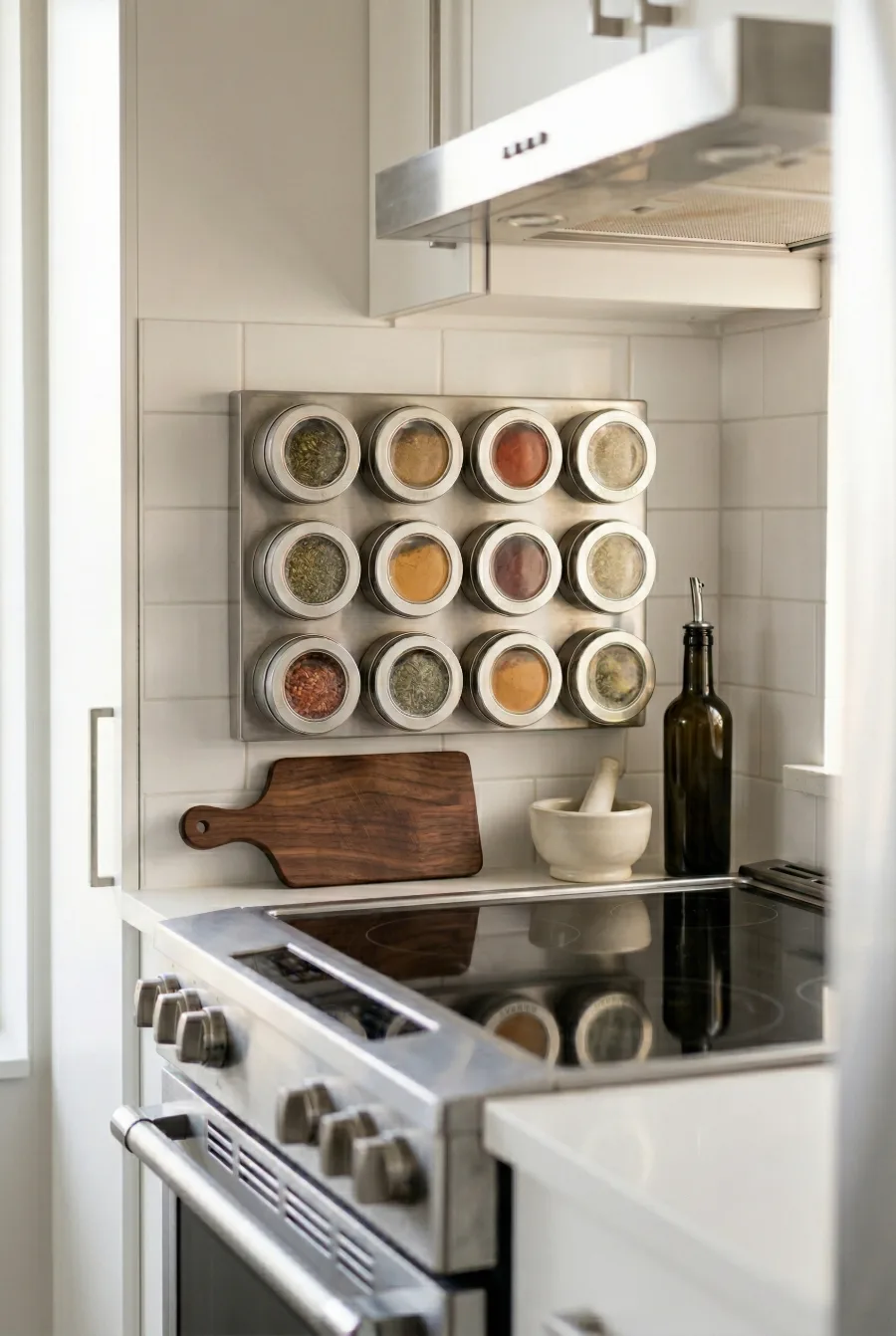
The spice situation in a small apartment kitchen is almost universally chaotic — bottles crammed into a cabinet where only the front row is visible, arranged on a counter edge where they fall over and take up precious prep space, or accumulated in a drawer where nothing is findable. A wall-mounted magnetic spice rack solves all of these problems in one installation. The rack mounts to the backsplash or any wall surface using adhesive strips or small screws, and the uniform small magnetic tins hold your most-used spices on the wall where they are visible, labeled, and reachable from the stove without moving a step. The counter directly beneath them becomes completely available for food preparation. The best magnetic spice rack systems use tins with a clear or window lid so you can see the spice color at a glance without reading the label. Matching labels — either printed or handwritten in the same pen — unify the appearance and make the spice wall look intentional rather than utilitarian. Stainless steel and acacia wood mounting strips are the most durable and most attractive options. Look for sets that include at least 20 tins since most active home cooks use more spices than they expect, and adding to the collection later with unmatched tins compromises the organized aesthetic.
The Under-Sink Organizer — Doubling a Cabinet That Nobody Thinks About
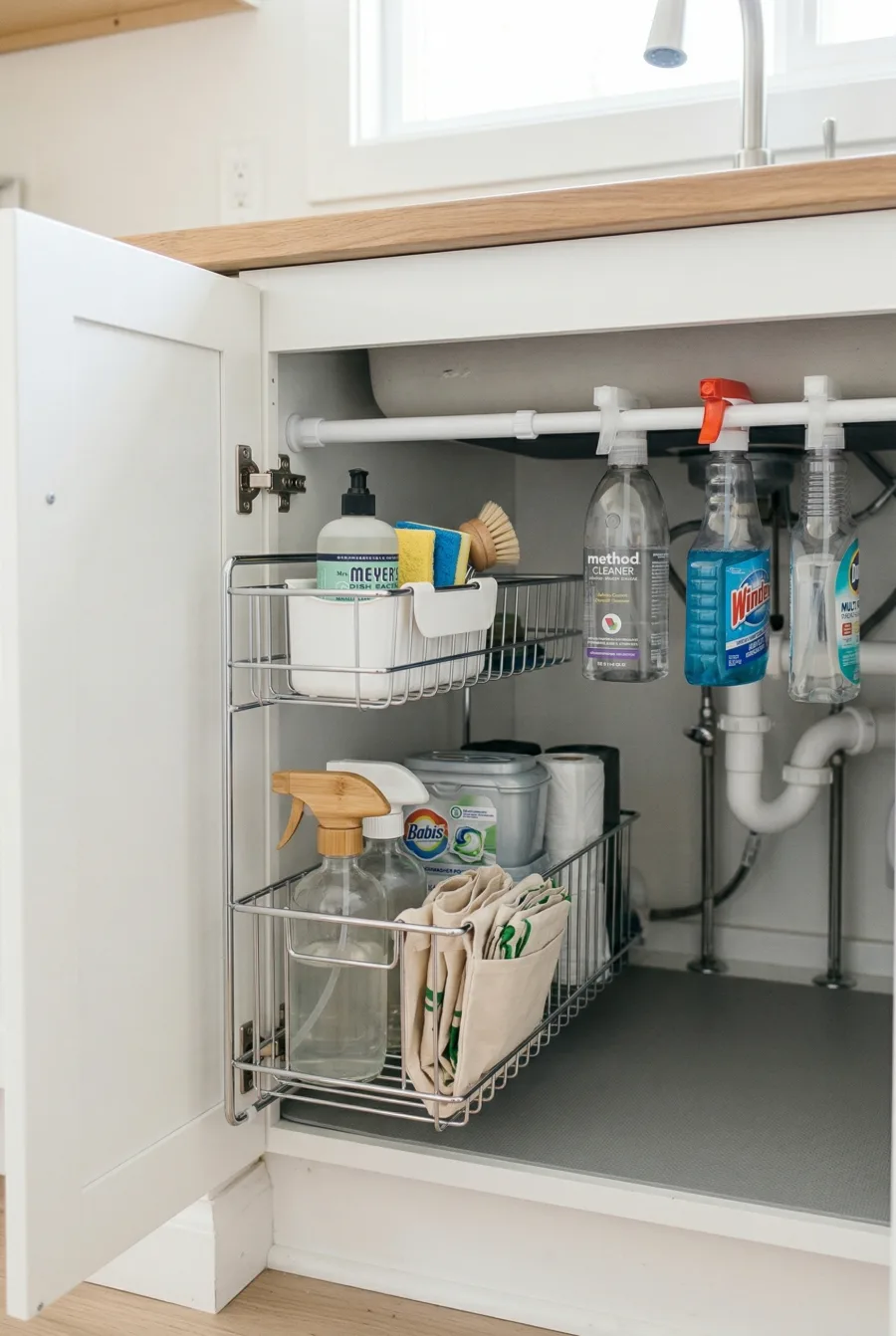
🛒 Under-Sink Cabinet Organizer — View on Amazon →
The cabinet beneath the kitchen sink is almost certainly the most disorganized storage space in your apartment. The plumbing takes up an irregular amount of space in the interior, making standard shelf inserts impossible. Items get pushed to the back and forgotten. Cleaning products fall over, leak, and create a general atmosphere of disorder. A properly designed under-sink organizer works around the plumbing with adjustable components — a two-tier pull-out drawer system with a cutout for the pipe, stackable corner organizers that fit around the plumbing, and a tension rod installed across the door opening to hang spray bottle handles. The transformation from default cabinet to organized under-sink zone takes approximately thirty minutes and costs very little but has an outsized impact on daily kitchen function. When evaluating under-sink organizer systems, look for adjustable configurations that can accommodate your specific pipe placement rather than fixed-dimension inserts that may not fit. Rust-resistant finishes — chrome or powder-coated steel — are essential in this moisture-prone cabinet. Labeled bins or clear containers for different categories (cleaning supplies, dish supplies, extra sponges) make everything findable and make restocking before it runs out much easier.
Kitchen Drawer Organizers — The Foundation of a Functional Kitchen
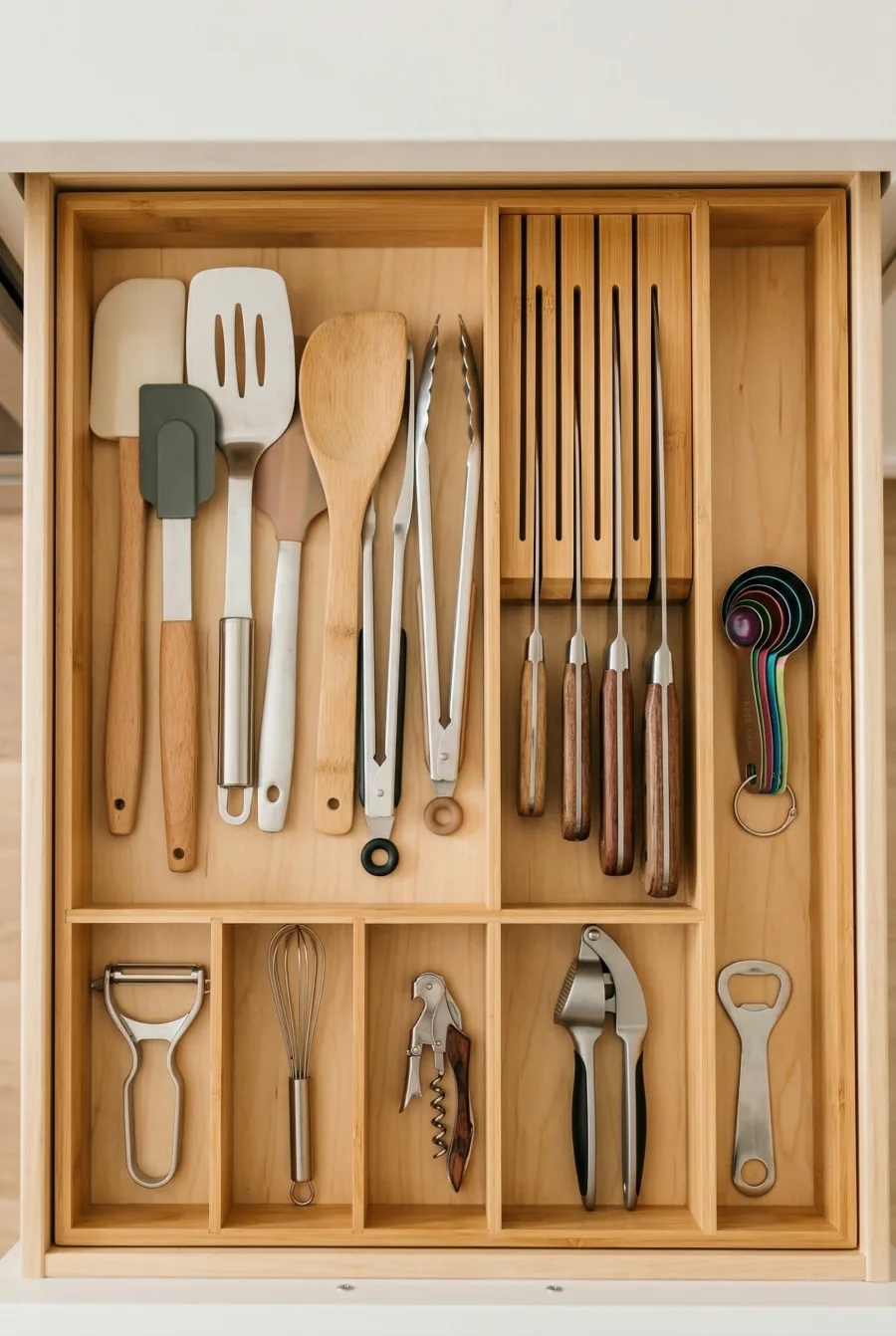
🛒 Kitchen Drawer Organizer — View on Amazon →
In a small apartment kitchen with limited drawer count, making each drawer work at maximum efficiency is not optional — it is essential. A kitchen where the utensil drawer is a tangled mess of tools forces you to dig every time you reach for a spatula, which adds time, friction, and low-level frustration to every meal preparation. A proper drawer organizer system — expandable bamboo dividers or a fitted multi-tray system — assigns a dedicated home to every category of kitchen tool within the drawer. Spatulas and tongs in one section, measuring spoons and a melon baller in another, knives in a built-in slot row, and small items in a compartmentalized front section. The result is a drawer where the location of every tool is immediately obvious and accessible. The best kitchen drawer organizer systems are expandable — they adjust to the exact width and depth of your specific drawer rather than leaving dead gaps at the sides. Bamboo options are warm and durable. Acrylic or clear plastic organizers have the advantage of visual uniformity. Fitted silicone drawer liners beneath the organizer prevent sliding and add grip. Even if you only organize one drawer in your kitchen, choose the most-used utensil drawer — the improvement to daily cooking ease is immediate and motivating.
Cabinet Shelf Risers — Doubling Your Pantry on One Shelf
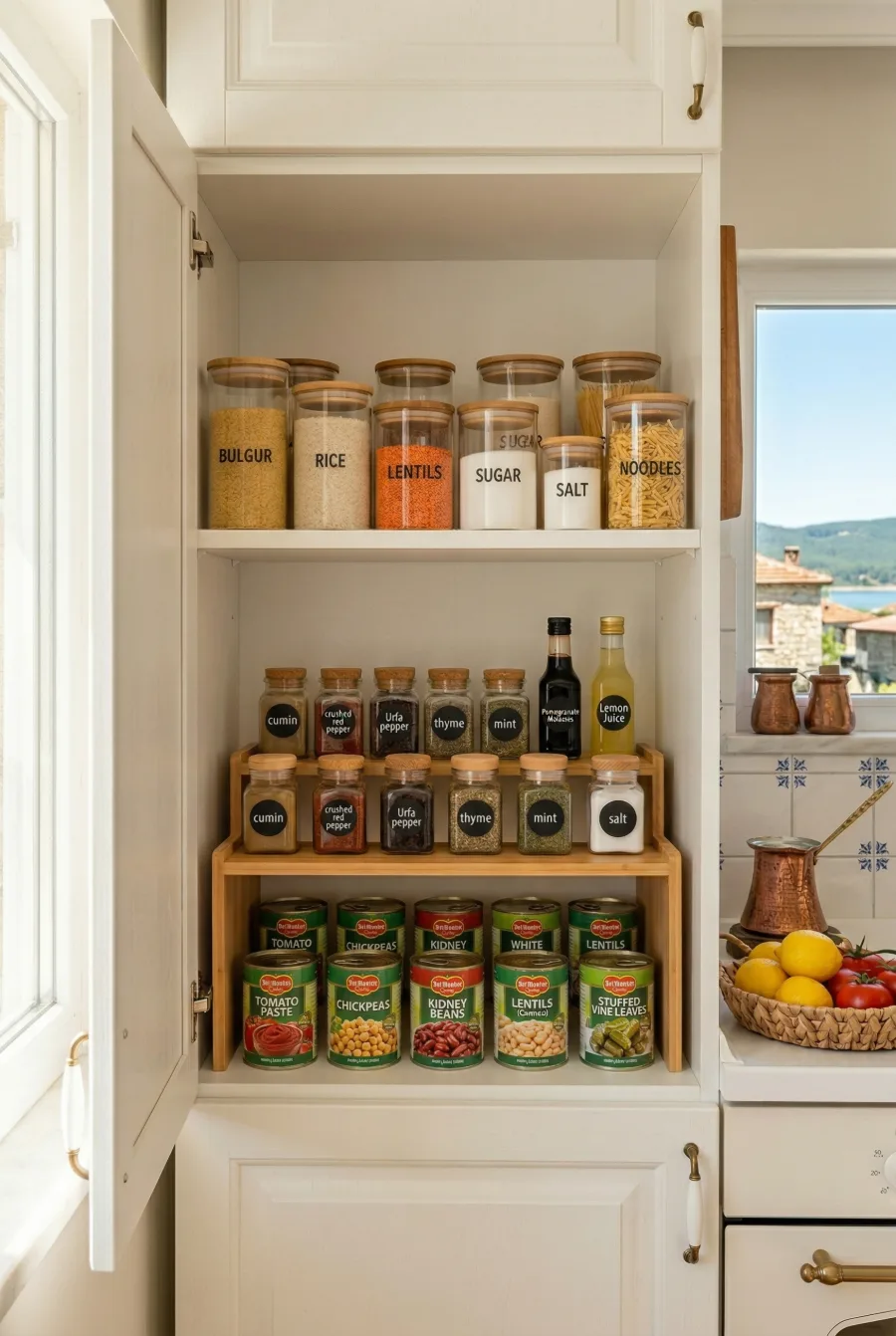
🛒 Cabinet Shelf Risers — View on Amazon →
Most kitchen cabinets waste a significant amount of their internal height because items on the single shelf don’t reach anywhere near the shelf above. A cabinet shelf riser addresses this directly by adding a raised platform within the cabinet, creating two usable levels from one shelf without any permanent modification. The lower level holds canned goods, jars, and bottles that sit at their natural height. The riser level sits approximately four inches higher and holds smaller items — spice bottles, sauce packets, small containers — that would otherwise be stacked awkwardly or hidden at the back. Every item becomes visible and accessible from the front of the cabinet without moving anything. Bamboo shelf risers are the most attractive and durable option, with a natural tone that looks intentional inside the cabinet. Wire versions are more affordable and allow you to see what’s on the lower level without opening the cabinet fully. For pantry cabinets with multiple shelves, a riser on each shelf can dramatically increase the total storage capacity without adding any additional furniture or modifying the cabinetry. A set of shelf risers in both small and medium sizes covers most kitchen cabinet configurations and represents one of the highest storage-gain-per-dollar investments available in kitchen organization.
Over-Door Pantry Organizers — Storage That Nobody Else Is Using
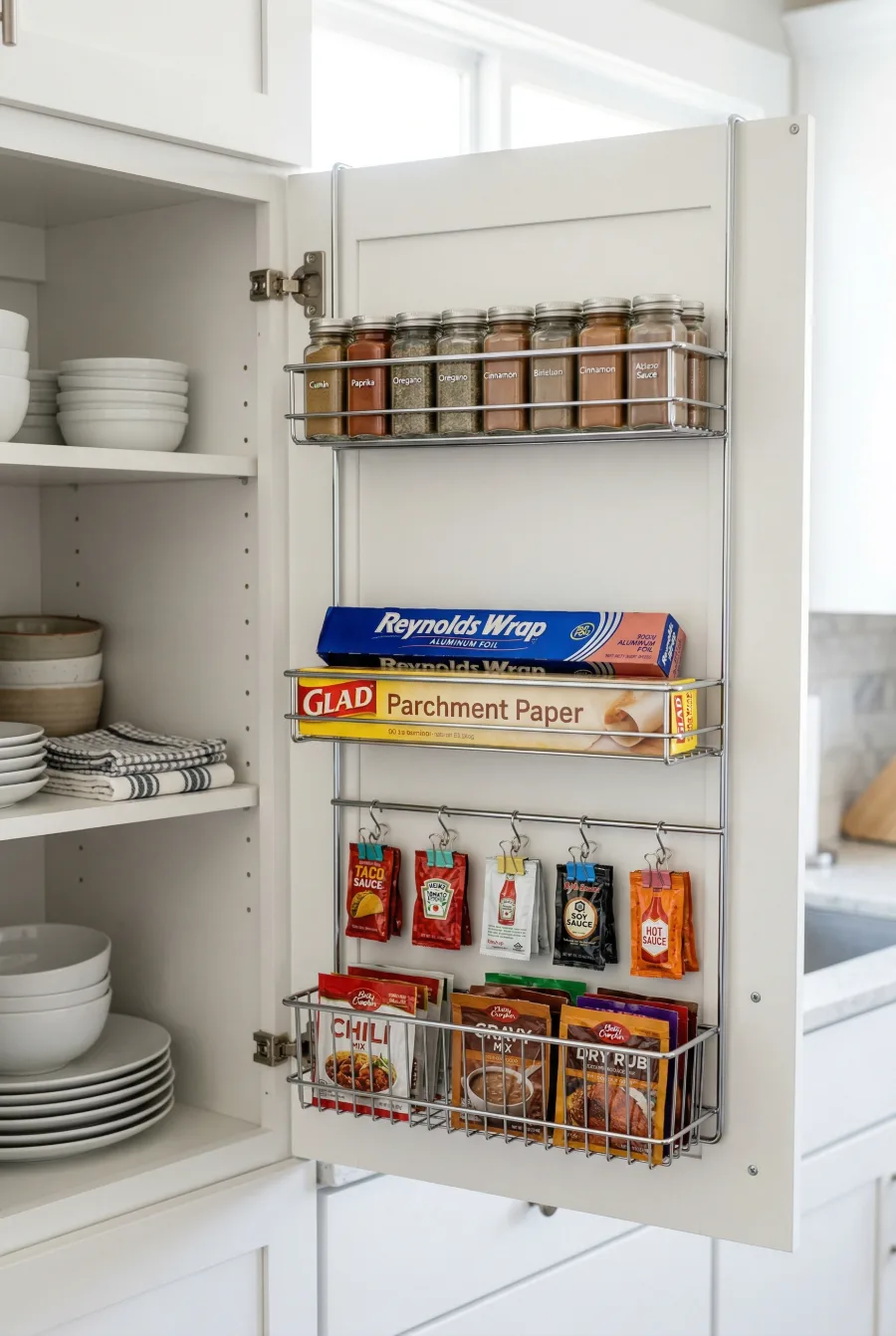
🛒 Over-door Pantry Organizers — View on Amazon →
The back of every cabinet door in a small apartment kitchen is a storage surface that the vast majority of apartment dwellers never use. It is smooth, accessible, load-bearing, and completely free. An over-door organizer rack hooks over the top of the cabinet door without any installation and adds three or more tiers of storage to the previously unused interior door surface. Spice bottles on the top tier, foil and parchment paper rolls in the middle, and sauce packets or seasoning envelopes in the lower section — all stored on the door that previously contributed nothing to the kitchen’s storage capacity. For the pantry cabinet specifically, an over-door organizer can hold enough items to essentially add a full extra shelf to the cabinet’s storage capacity. Wire or chrome racks are the most common and most affordable. Clear acrylic pocket organizers are ideal for smaller items that would otherwise fall through wire gaps. Make sure the organizer is narrow enough that when the cabinet door closes, the rack clears the adjacent shelf contents — measure the gap between the open door’s position and the nearest shelf before purchasing. Most over-door systems accommodate doors up to a standard width, but verify the door thickness is within the hook range specified.
Pull-Out Cabinet Drawers — Finally Making Deep Cabinets Work
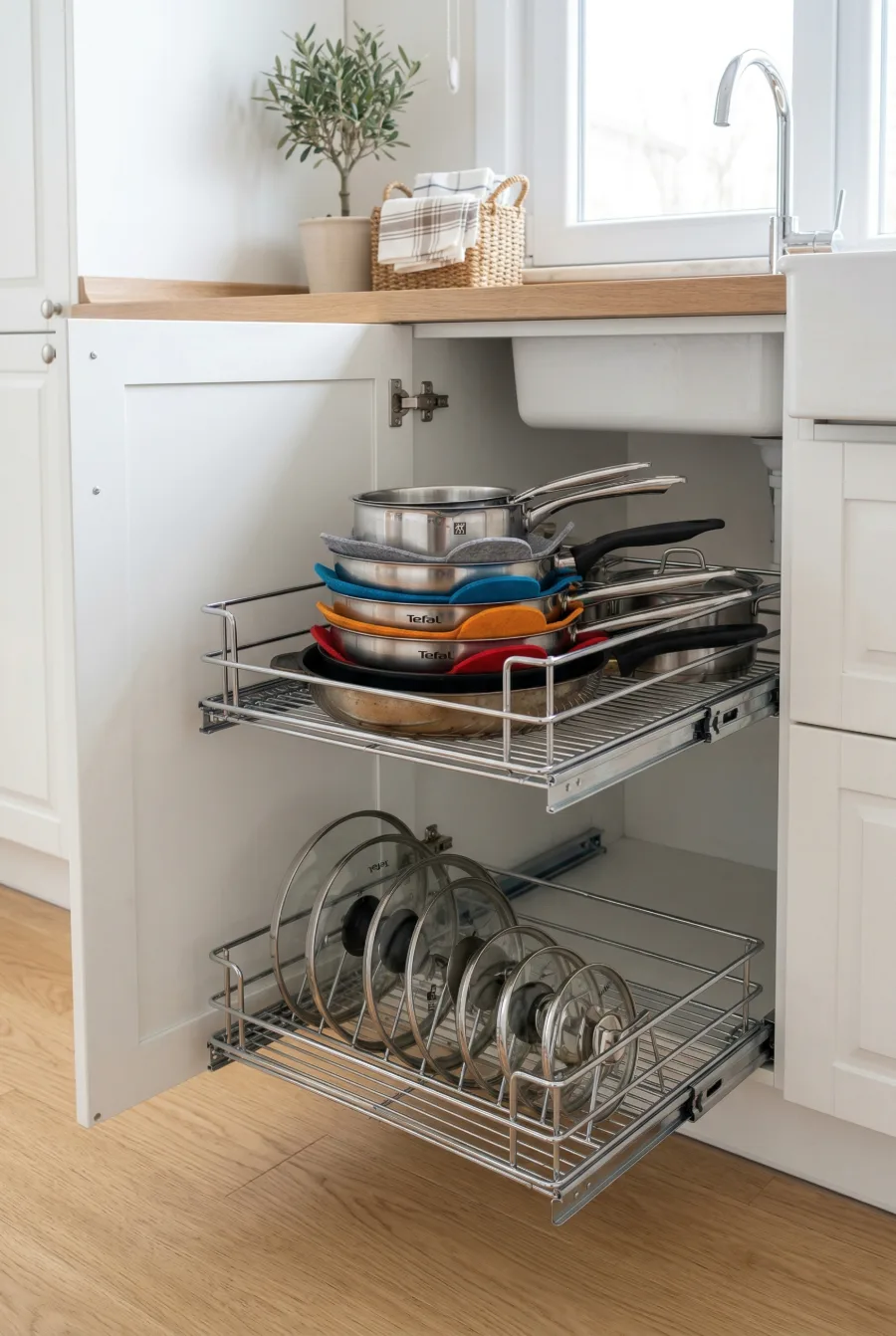
🛒 Pull-Out Cabinet Drawers — View on Amazon →
Deep lower kitchen cabinets are one of the most universal sources of kitchen frustration in small apartments. The cabinet is perhaps 24 inches deep and the items at the back require you to crouch, reach, and excavate to access anything that was pushed behind the front row. A pull-out drawer insert installed inside the lower cabinet transforms this experience entirely — the drawer extends on full-extension slides and brings everything from the back of the cabinet forward simultaneously. Nothing is buried, nothing is forgotten, and nothing requires crouching and reaching. The best pull-out cabinet drawer systems are rated for significant weight — particularly important in lower cabinets that hold heavy cast iron pans, pots, and appliances. Soft-close mechanisms prevent slamming and extend the hardware life significantly. For a rented apartment where permanent cabinet modification is not permitted, look for tension-mounted pull-out systems that use pressure to hold in position without screws or drilling. These are slightly less stable than screwed systems but work adequately for lighter loads. For cooking equipment that is heavy and used frequently, a properly installed screw-mounted pull-out drawer is worth negotiating with the landlord since it does not damage the cabinet structure in any meaningful way.
The Magnetic Knife Strip — Knives Off the Counter and on the Wall
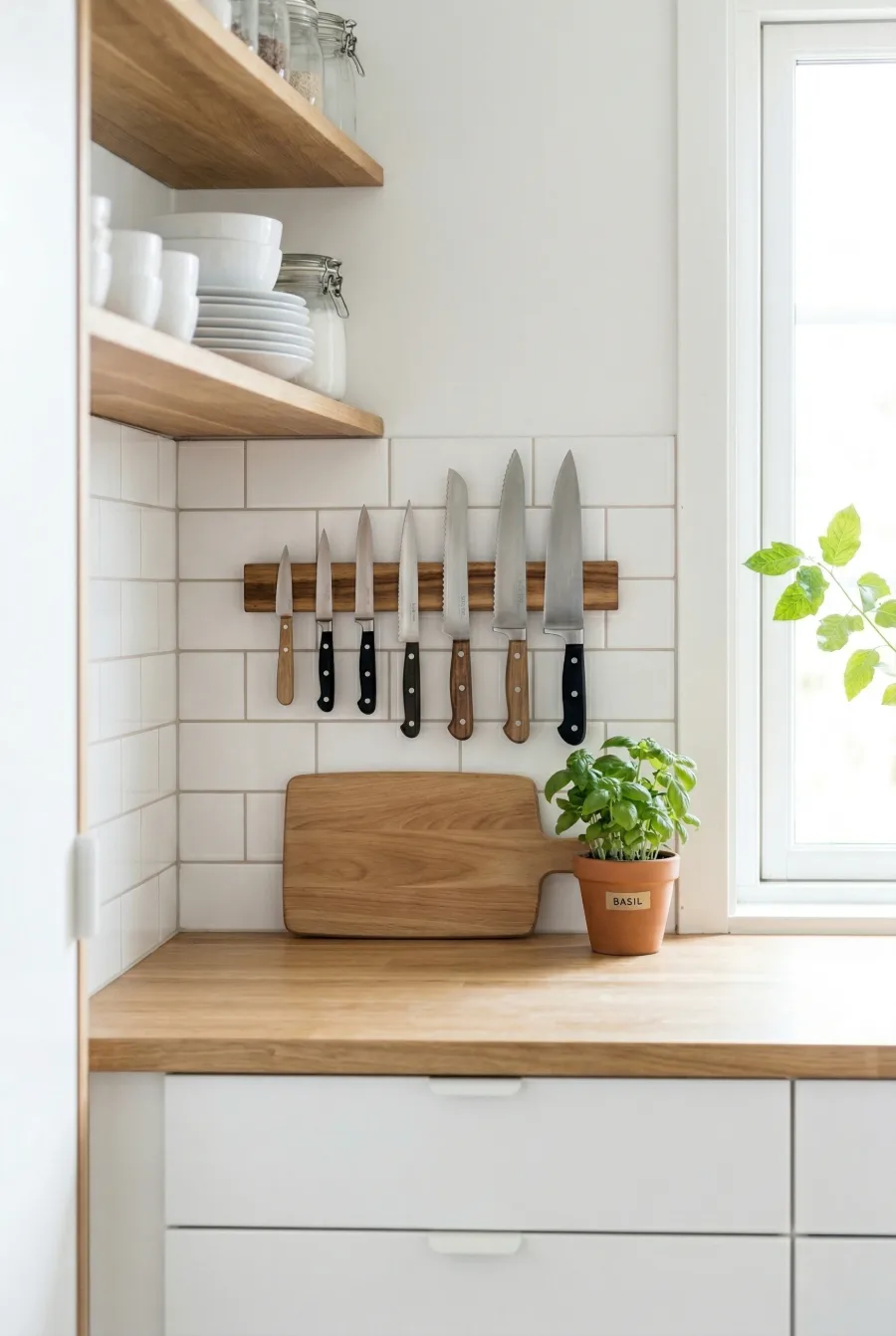
🛒 Magnetic Knife Strip — View on Amazon →
A knife block sitting on the kitchen counter of a small apartment is occupying some of the most valuable real estate in the home — the limited counter surface that you need for food preparation. A wall-mounted magnetic knife strip relocates the entire knife collection from horizontal counter space to vertical wall space, freeing up the block’s footprint while making the knives more accessible — they are visible, reachable with one hand, and displayed in order of size so selection is instant. The magnetic attachment is strong enough for any standard kitchen knife and gentle enough to not damage edges when blades are placed carefully. The most attractive magnetic knife strips are made from solid acacia or walnut wood with embedded magnets — the wood tone adds warmth to the backsplash area rather than the clinical look of all-metal versions. Stainless steel versions are easier to clean and more hygienic in a busy kitchen. Installation requires either a couple of small screws into the backsplash or wall, or high-strength adhesive strips for surfaces where drilling is not permitted. Knife edges should be placed against the strip at an angle rather than straight on to avoid damaging the blade geometry over time. A magnetic strip wide enough for seven to ten knives covers most kitchen requirements with room for kitchen shears and a honing steel.
Matching Pantry Container Systems — The Visual Upgrade With Practical Benefits
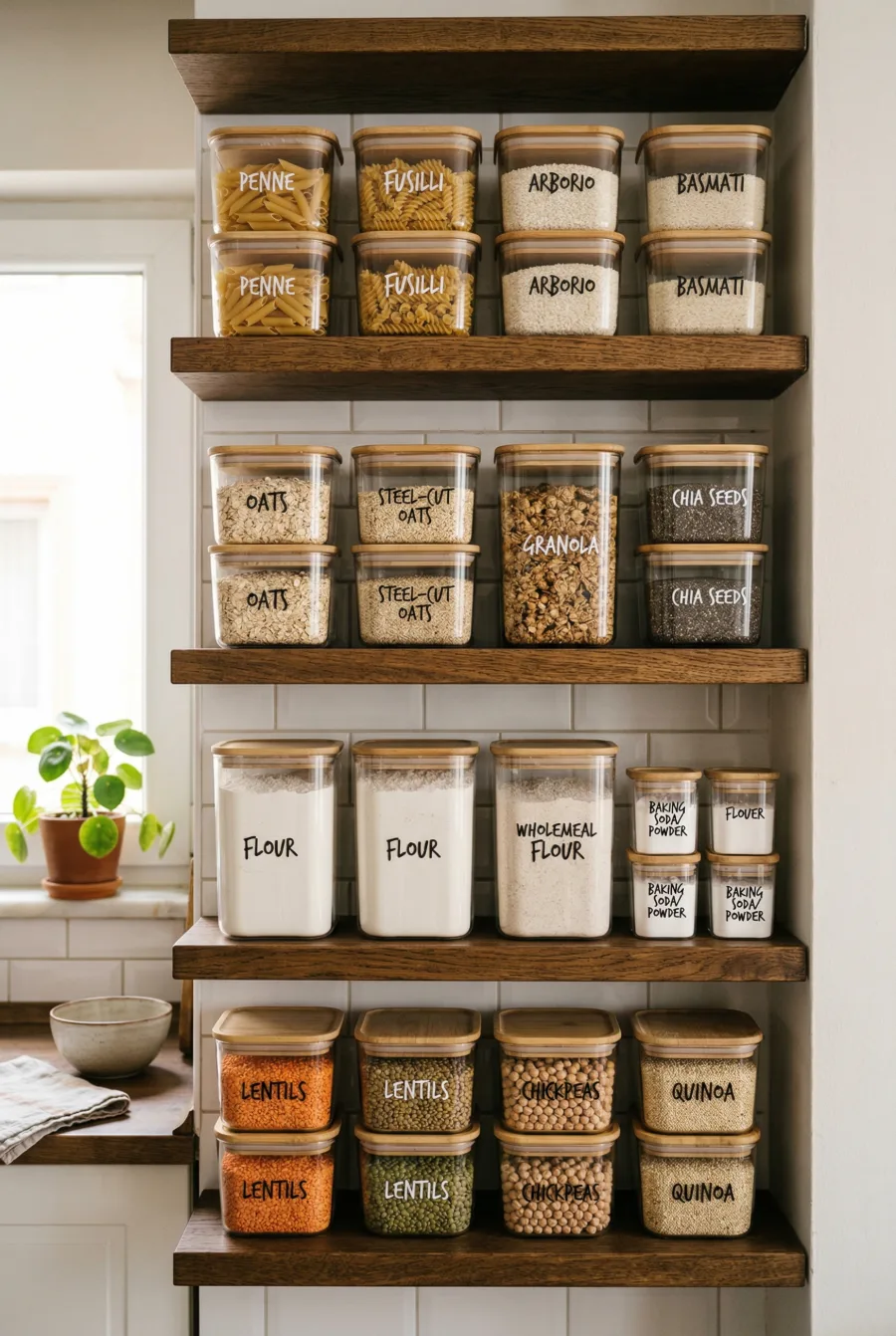
🛒 Pantry Containers — View on Amazon →
Transferring dry goods from their original packaging into a uniform system of matching containers is the single most visually transformative thing you can do to a small kitchen pantry — and it has genuine practical benefits beyond aesthetics. Uniform containers stack more efficiently than bags and boxes of irregular sizes, recovering significant vertical space on each shelf. Every item is immediately visible through the container walls without having to move things around. Portion assessment is instant — you can see at a glance when something is running low rather than discovering an empty bag at the moment you need it most. Stacked containers in a consistent system also make shelf cleaning dramatically easier since everything lifts out in one organized motion. The best pantry container systems for small apartments use square or rectangular bases rather than round, since square containers tessellate perfectly and leave no wasted space between containers on the shelf. Glass with airtight bamboo lid closures are the most beautiful and most food-safe option. For a complete small apartment pantry, a set of at least 20 containers in two or three sizes — tall for pasta and rice, medium for grains and legumes, small for spices and baking ingredients — provides enough coverage for a functional decanted pantry without over-investing.
The Corner Lazy Susan — Ending the Cabinet Archaeology Forever
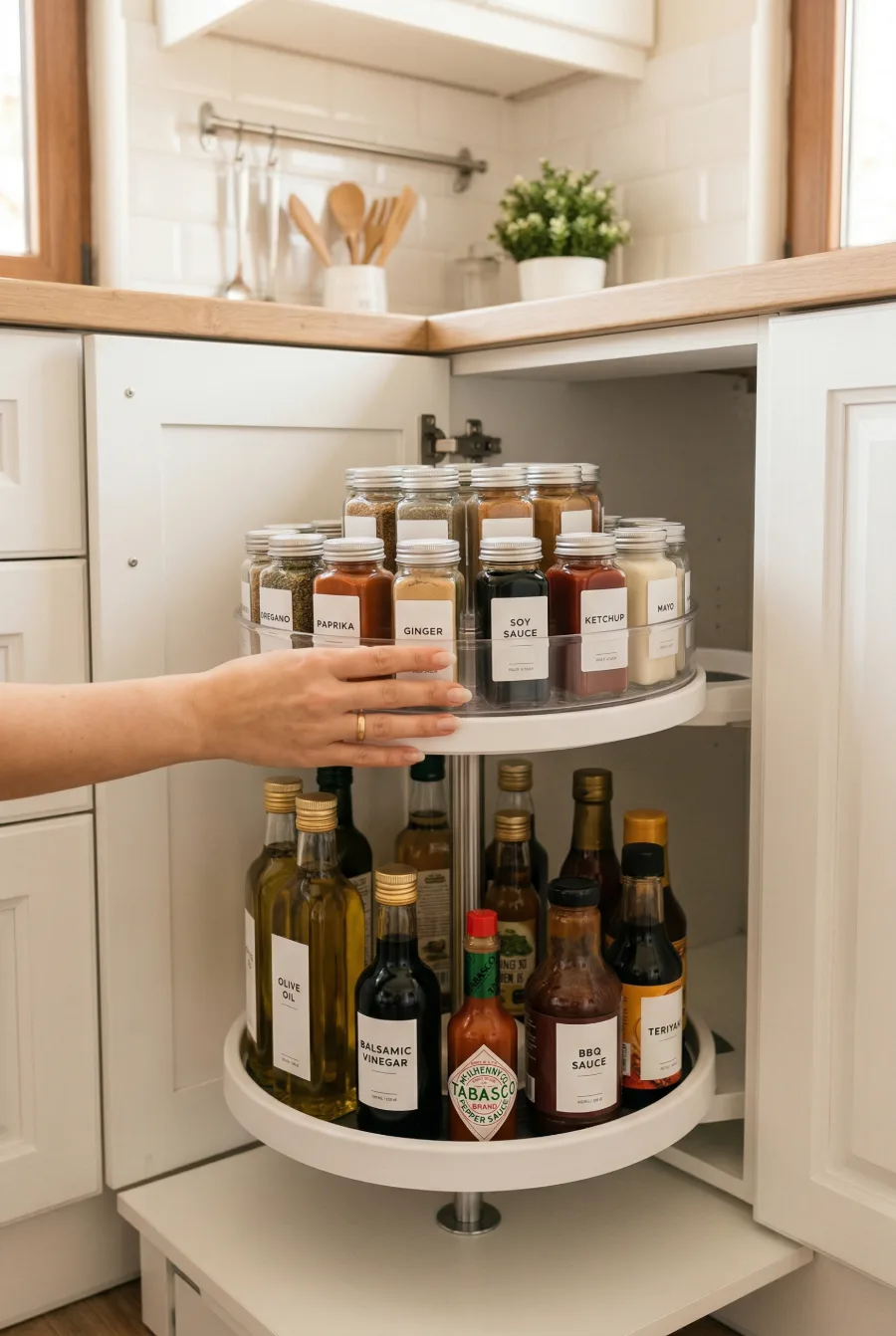
🛒 Corner Lazy Susan Organizer — View on Amazon →
Corner kitchen cabinets are responsible for more lost ingredients, forgotten duplicates, and general kitchen chaos than any other storage zone. The depth and geometry of a corner cabinet makes the back completely inaccessible without removing the entire front row, which discourages people from bothering and results in the back third of the cabinet becoming a permanent dead zone of items that are technically in the kitchen but effectively lost. A lazy susan turntable installed inside the corner cabinet eliminates the dead zone entirely — every item rotates to the front with a simple spin. A two-tier lazy susan maximizes the vertical space as well, creating a lower level for heavier items and an upper level for lighter ones. For corner cabinets with a blind section that extends beyond the door opening, a pull-out lazy susan — one that extracts on a slide mechanism before rotating — provides access to items that a standard spinning base cannot reach. When sizing a lazy susan for a corner cabinet, measure the interior diameter carefully since most lazy susans come in standard sizes that may leave a gap at the cabinet walls. A non-slip base beneath the lazy susan prevents the entire unit from rotating when you spin the turntable. This is one of the simplest and most immediately satisfying kitchen organization upgrades available.
Floating Kitchen Shelves — Open the Space and Display Your Best Things
🛒 Floating Kitchen Shelves — View on Amazon →
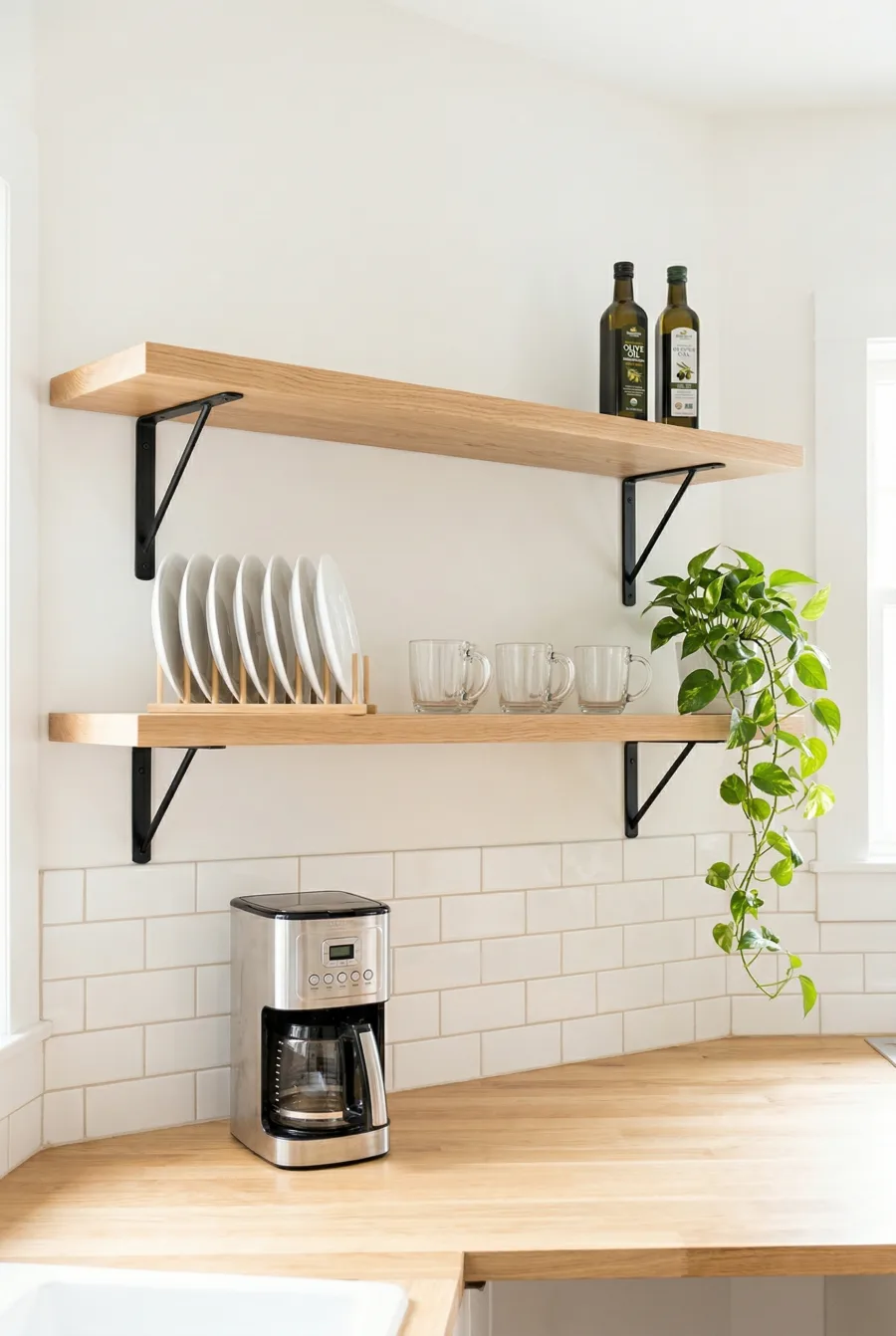
Replacing upper kitchen cabinets with open floating shelves is one of the most popular small kitchen upgrades because it addresses the two most common complaints simultaneously — the kitchen feels cramped and closed, and the upper cabinets are difficult to access. Open shelves break the visual heaviness of upper cabinetry and make the kitchen feel dramatically larger and lighter. They place the items you use most within immediate visual and physical reach rather than behind doors. And they transform the functional storage zone into a display space for beautiful ceramics, glassware, and small plants that make the kitchen feel like a lived-in and loved room rather than a utility space. The practical requirement of open shelving is curation — every item on the shelf is visible and becomes part of the kitchen’s visual character. This means investing in kitchen basics that you actually want to look at: a set of matching ceramic mugs, good quality glass storage jars, a few small plants, and your most attractive cookbooks displayed spine-out. Items that are purely functional and not beautiful should move to lower cabinets or be decanted into uniform containers. Floating shelf brackets in hairpin or minimalist metal designs are the most current aesthetic choice and work in both modern and Scandinavian kitchen styles.
Under-Cabinet Rail and Hook Systems — The Hanging Kitchen
🛒 Under-Cabinet Rail with Hooks — View on Amazon →
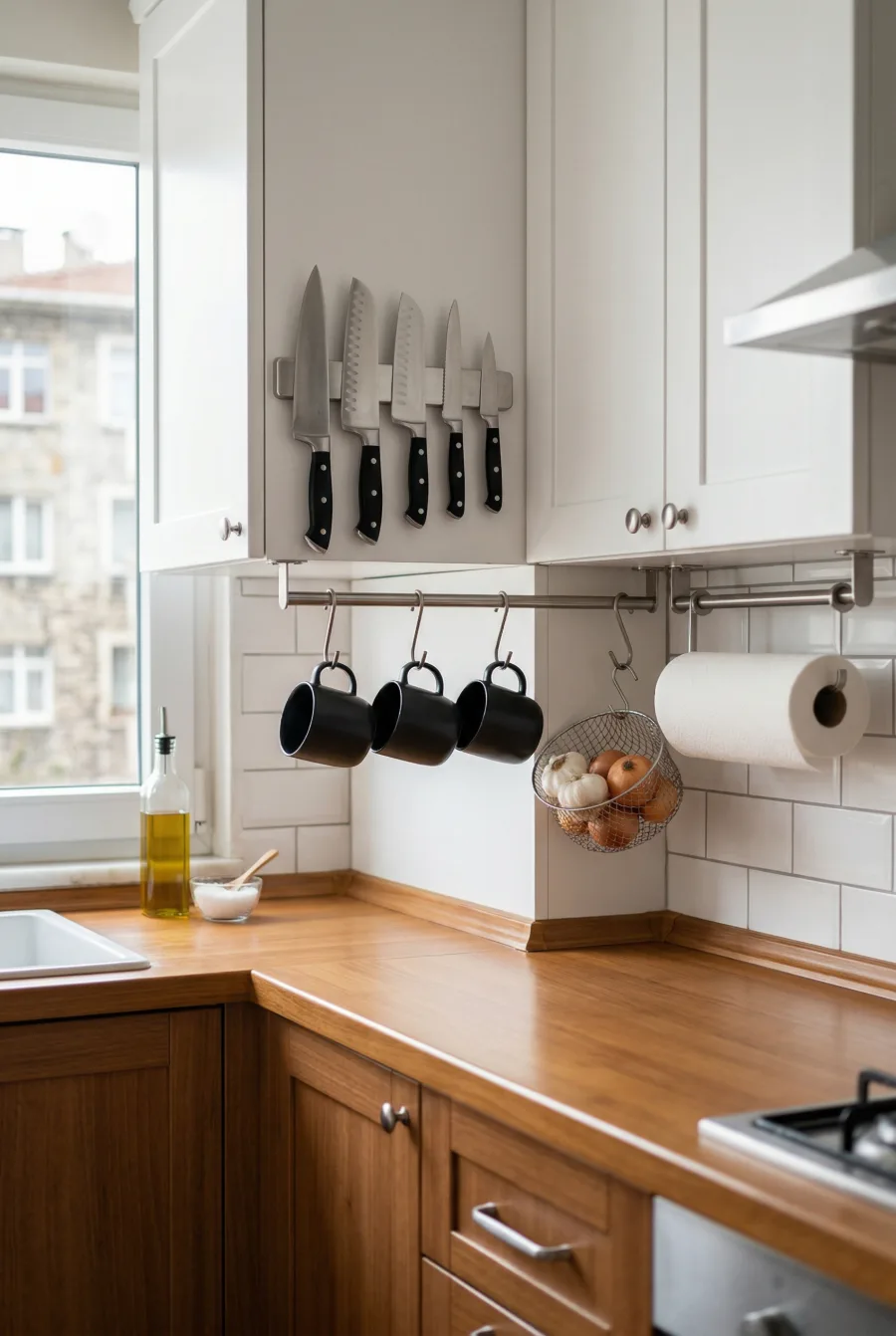
The underside of upper kitchen cabinets is another consistently underutilized surface in small apartment kitchens. A rail system mounted to the cabinet bottom edge creates a hanging infrastructure for mugs, utensils, paper towels, wine glasses, and any other kitchen item that can be suspended rather than stored horizontally. The visual effect of a well-configured under-cabinet rail system is of a kitchen that is using its space at a sophisticated level — the cabinet bottom becomes a functional storage surface rather than dead space. S-hooks on the rail hold individual items. Basket inserts that clip to the rail hold small items that wouldn’t otherwise hang. A mounted paper towel holder eliminates the counter-standing paper towel unit. Wine glass holders that clip to the rail and hold stems in individual slots are available in chrome and matte black finishes. The rail itself comes in various lengths and can be cut to fit any cabinet span. Installation typically requires small screws into the cabinet bottom, making this appropriate for either a rental where small screw holes are acceptable or an owned apartment. Command strip mounting options exist for truly no-damage installation but are rated for lighter loads — appropriate for mugs and utensils but not for wine glasses or heavy items.
Countertop Appliance Organization — Curating Your Surface
🛒 Counter-Top Appliance Organizers — View on Amazon →
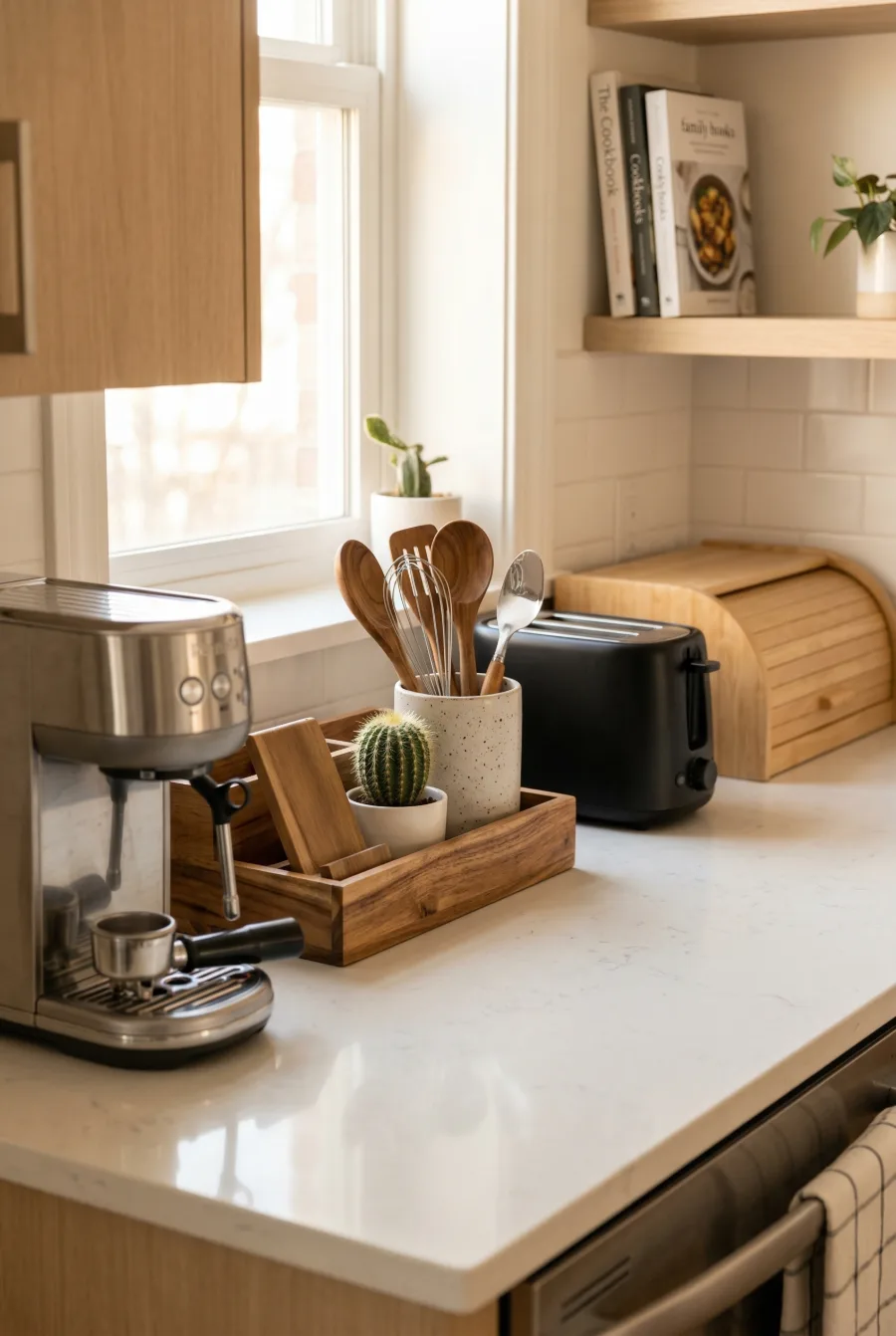
In a small apartment kitchen, the countertop is the single most contested surface — it needs to accommodate food preparation, small appliance use, and enough clear space to work comfortably. The key to a functional and beautiful small kitchen countertop is radical curation. Every item that lives on the counter needs to earn its place through daily use. Appliances used less than three times a week should find a home in a cabinet or appliance garage rather than occupying permanent counter space. The appliances that stay — typically the coffee maker, the toaster, and perhaps the kettle — should be grouped intentionally on one section of the counter with a coordinating tray or surface mat beneath them. This appliance zone approach treats the counter collection as a curated display rather than an accumulation. A wooden tray or a marble slab beneath the grouped appliances creates a visual frame that makes the arrangement look intentional. Matching appliance finishes — all matte black, all stainless, or all white — unify a collection that might otherwise look mismatched. The remaining counter space should be completely clear except for one cutting board standing vertically against the backsplash. The discipline of keeping countertops clear is the single most impactful organizational habit in a small kitchen.
Pot Lid Organization — Ending the Cabinet Avalanche
🛒 Pot-Lid Organizers — View on Amazon →
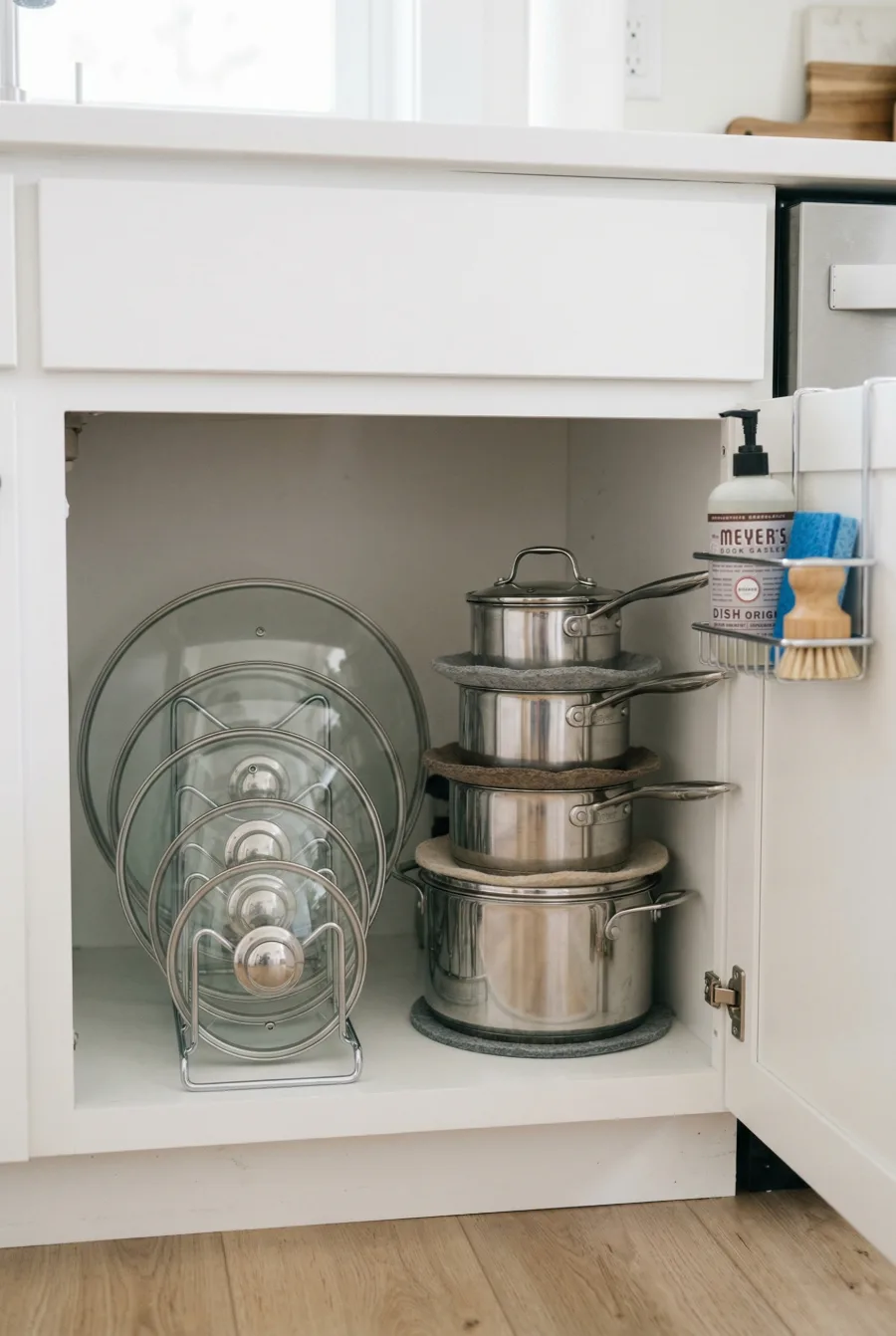
Pot lids are the most universally chaotic item in any small apartment kitchen cabinet. They are flat, heavy, awkward to stack, and impossible to sort through without triggering a minor avalanche. Storing them horizontally in a pile means extracting the bottom lid requires removing every lid above it. A vertical pot lid organizer solves this completely — each lid stands upright in its own slot and can be individually accessed without disturbing any other lid. Cabinet-door-mounted organizers are the most efficient option since they use the door surface rather than taking up shelf space. Freestanding vertical lid racks that sit on the cabinet shelf between the pots are the alternative for cabinets where door mounting is not practical. The organizer should have at least five to six slots of varying widths to accommodate the range of lid sizes in a typical kitchen. Chrome or stainless steel wire lid organizers are the most affordable and adequately functional. Bamboo slot systems are more attractive and worth the modest price premium for kitchens where the cabinet interior is occasionally visible. This is one of those kitchen organization upgrades that is easy to overlook because the problem is hidden inside a cabinet — but it is also one of the fastest improvements to daily kitchen function you can make.
The Magnetic Refrigerator Side Panel — Vertical Kitchen Storage Nobody Uses
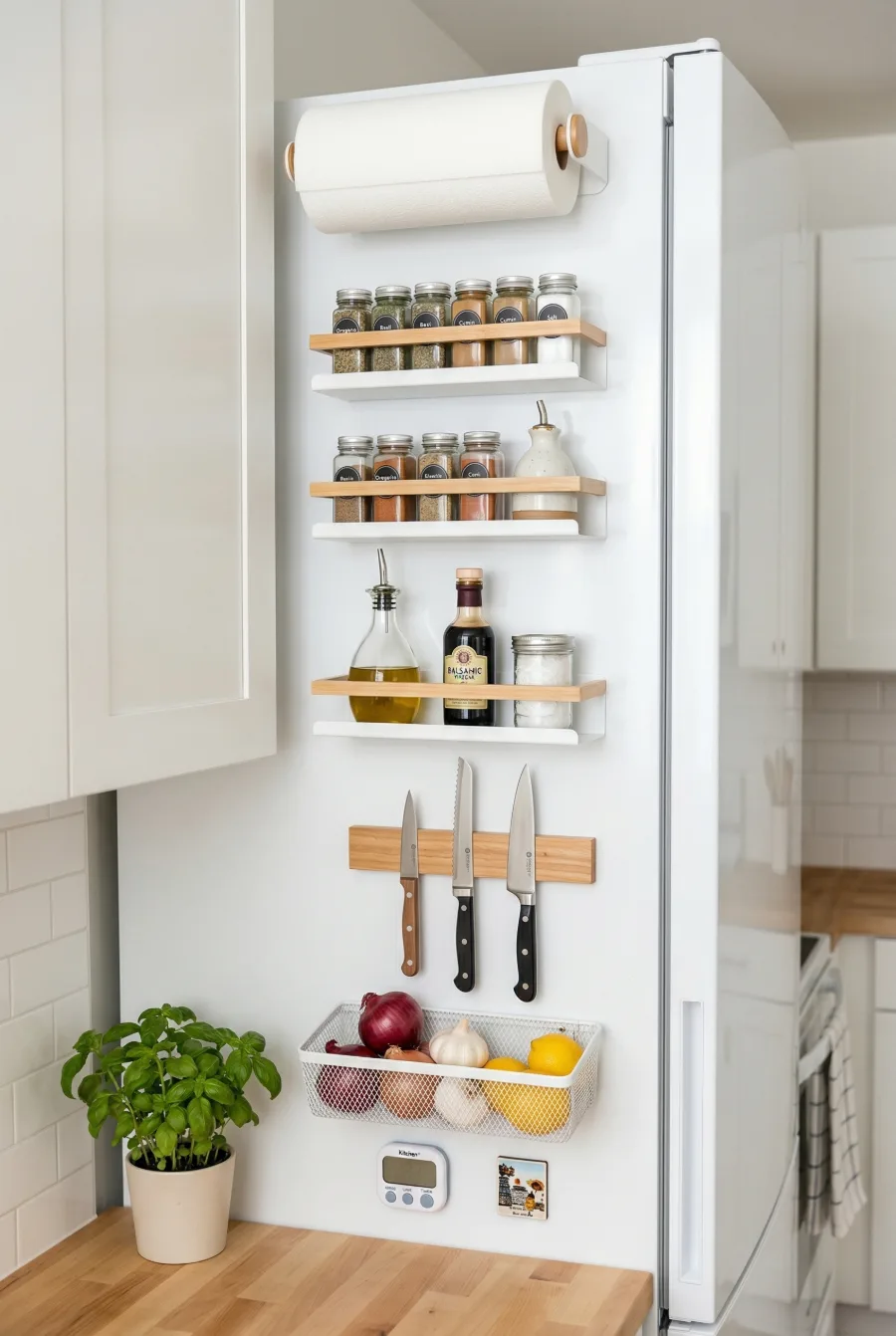
🛒 Magnetic Kitchen Storage Items — View on Amazon →
In a small apartment kitchen, the side panel of the refrigerator is a large, flat, vertical surface that is magnetically receptive and almost entirely wasted. Magnetic storage attachments designed specifically for the refrigerator side can transform this surface into a fully functional storage zone in minutes with no drilling, no adhesive, and no commitment. A magnetic paper towel holder at the top eliminates the counter-standing roll. Below it, magnetic shelves hold small spice bottles, olive oil, and frequently used condiments within arm’s reach of the stove. A magnetic knife strip holds three small knives and a peeler. A magnetic whiteboard or notepad holds the grocery list. In total, the refrigerator side can absorb a significant portion of the counter clutter that most small apartment kitchens struggle to manage, without requiring any new furniture or additional floor space. The key practical requirement is a refrigerator with a steel rather than aluminum side panel — magnetic attachments do not adhere to aluminum or glass door refrigerators. Confirm your refrigerator’s side panel material with a small magnet before purchasing the organizer system. Stainless steel magnetic accessories in a consistent finish look the most polished and resist moisture and grease well.
The Rolling Kitchen Cart — Counter Space on Wheels
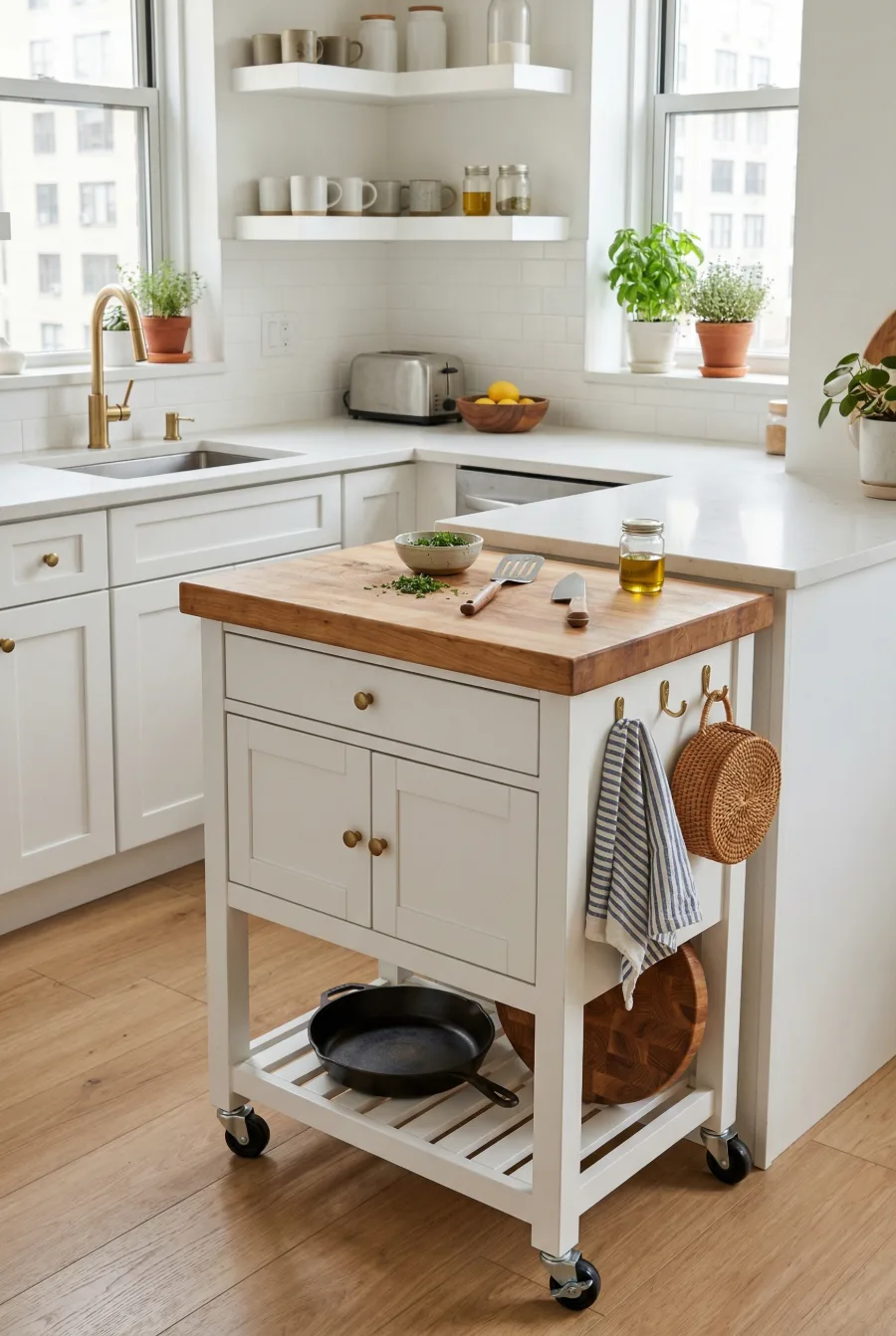
🛒 Rolling Kitchen Cart — View on Amazon →
A rolling kitchen cart is the most versatile kitchen storage addition for a small apartment because it performs multiple functions and relocates to wherever it is most needed. During cooking it rolls beside the counter to extend the preparation surface. During dinner it rolls to the dining area and functions as a serving station. After cooking it parks against the wall or in a hallway corner and provides storage without occupying any of the kitchen’s fixed floor space. The best rolling kitchen cart designs have a butcher block top that can handle actual knife use, a lower enclosed cabinet or open shelf for pot and pan storage, side hooks for utensils and dish towels, and lockable casters so the cart stays stationary when in use. Caster quality matters enormously — cheap plastic wheels roll poorly on anything other than perfectly smooth floors and tend to fail under load. Look for polyurethane casters rated for at least 50 pounds per wheel. The cart height should match your existing counter height — typically 36 inches — for seamless use as an extended work surface. A cart that is slightly too tall or too short creates an ergonomic problem that will bother you every time you use it. This is a product category with a wide price and quality range — investing in a cart that is solid and durable pays off over years of daily use.
The Kitchen Sink Caddy — Organizing the Most-Used Spot in the Kitchen
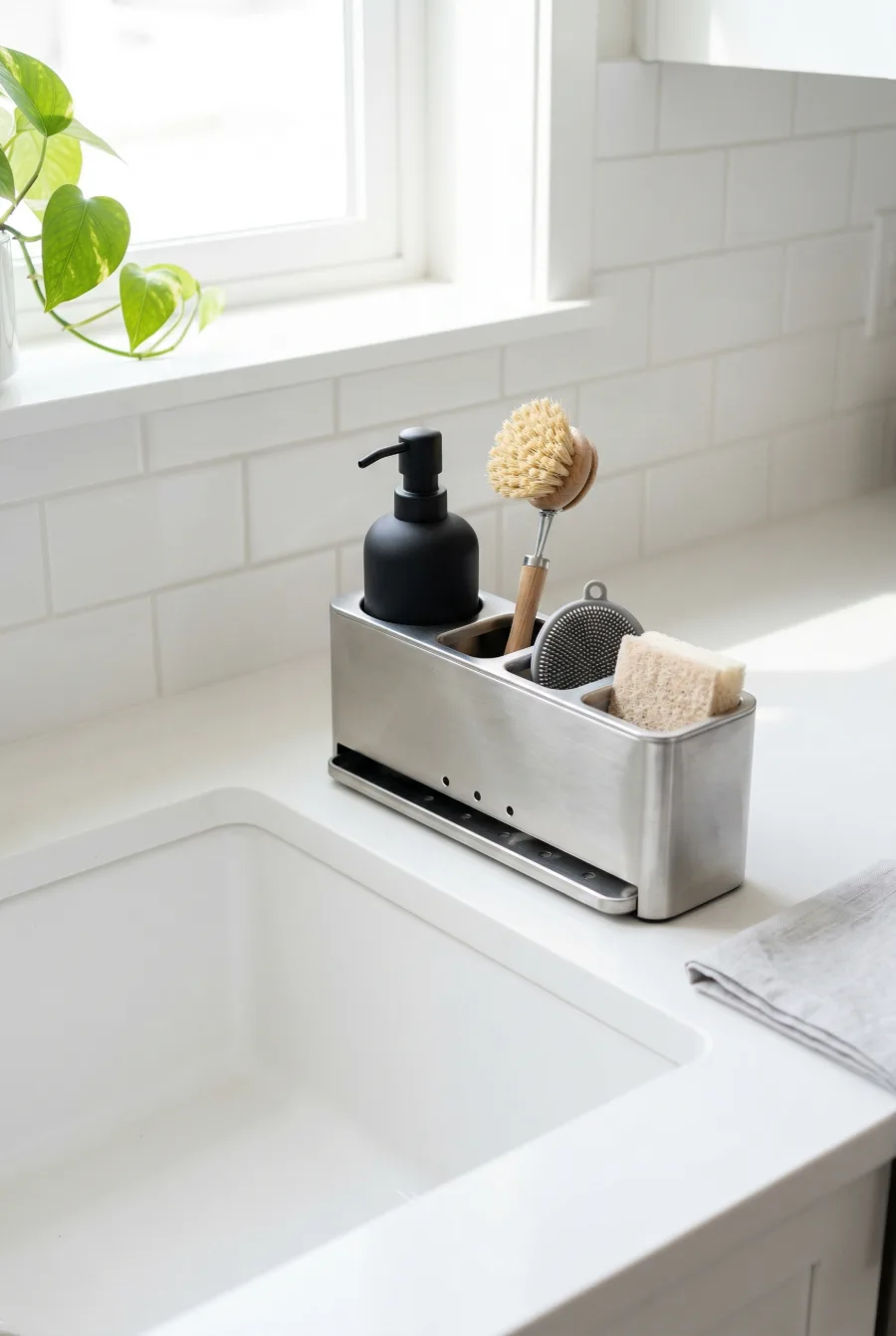
🛒 Kitchen Sink Caddy — View on Amazon →
The area immediately surrounding the kitchen sink in a small apartment is almost always cluttered — dish soap on one side, a pile of sponges on the other, a scrub brush balanced on the edge, and a half-empty bottle of hand soap somewhere in the middle. A sink caddy organizer consolidates all of these essentials into one organized unit with drainage holes in the base to prevent the standing water that causes mold and deterioration. The best sink caddy designs have individual compartments for each item — a soap dispenser slot, a sponge holder with drainage, a slot for a dish brush, and a small compartment for a scraper or small cleaning tool. Stainless steel caddies are the most hygienic and easiest to clean. Bamboo versions are warmer in appearance but require more maintenance to prevent moisture damage. The soap dispenser used with the caddy should be a quality refillable pump model rather than the original soap bottle — a matte black or brushed steel pump dispenser instantly elevates the aesthetic of the sink area compared to a commercial plastic bottle. Replacing the original soap bottle with a uniform dispenser and a matching scrub brush set is the simplest and most affordable countertop upgrade available, and it takes three minutes.
Vertical Plate Racks — The Smarter Way to Store Plates
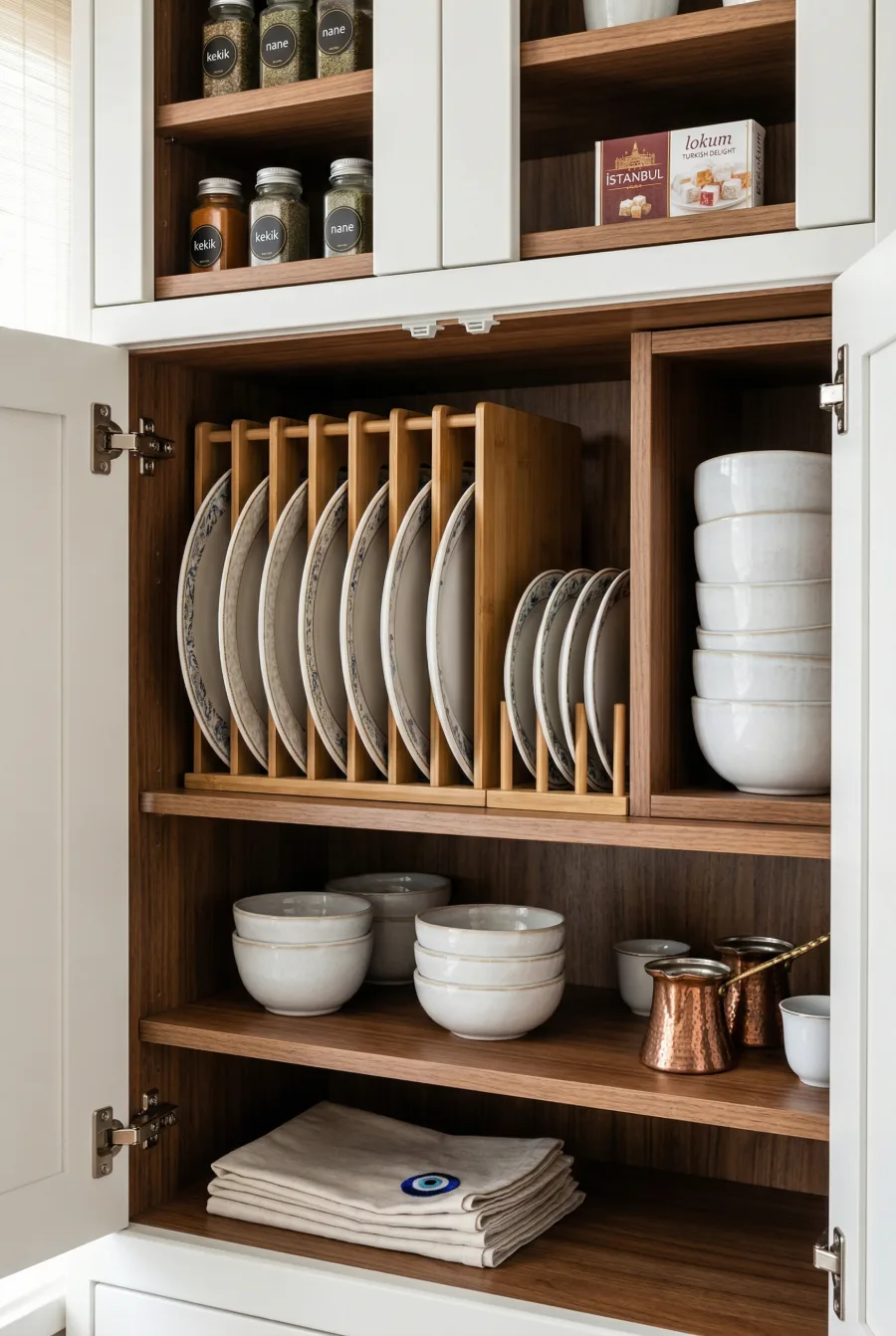
🛒 Vertical Plate Racks — View on Amazon →
Plates stored in horizontal stacks in a kitchen cabinet require a specific sequence of removal — you cannot access the bottom plate without lifting every plate above it. In a small apartment kitchen where you may use different sizes of plate for different meals, this creates daily friction and the risk of chipping as plates are shuffled. A vertical plate rack stores plates standing upright in individual slots, which means any plate can be removed independently without disturbing the others. The access is instant, the risk of chipping is eliminated, and the storage efficiency is improved since plates standing vertically take up less horizontal shelf footprint than the same number stacked. Bamboo vertical plate racks are the most popular and most attractive option, available in configurations that hold four to twelve plates in sizes from side plate to large dinner plate. Wire chrome versions are more affordable and easier to clean. For a complete plate storage solution, a combination of a vertical plate rack for dinner plates and a simple horizontal stack riser for bowls makes efficient use of the available cabinet space. This is an affordable upgrade — quality bamboo plate racks are available for a modest price — with immediate and daily practical benefit. It also makes unpacking the dishwasher faster since plates can be slid directly into their vertical slots.
The Over-Stove Shelf — Prime Real Estate You’re Not Using
🛒 Over-Stove Shelf — View on Amazon →
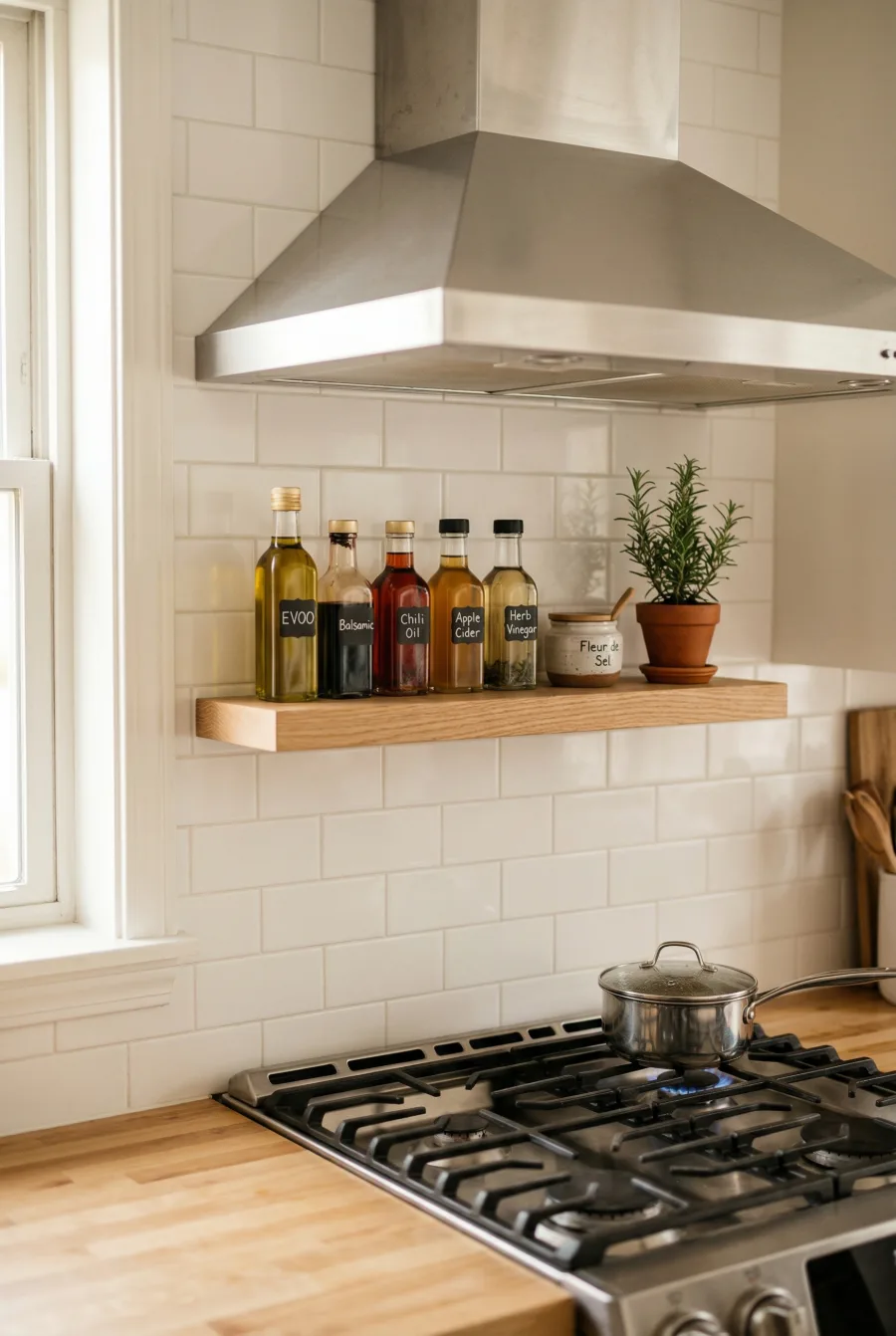
The wall area above the stove — between the stovetop surface and the range hood or upper cabinet — is the most valuable real estate in a small apartment kitchen and in most kitchens it contains nothing. A narrow floating shelf mounted in this zone creates a dedicated storage area for the items you reach for most while cooking — olive oil, the oils and fats you cook with, salt, the three or four spices you use in almost every meal. Having these within arm’s reach of the stove eliminates the step back and cabinet-opening sequence that interrupts cooking flow multiple times in every meal preparation. The shelf should be narrow — six to eight inches deep is sufficient — since it needs to clear the range hood and not impede ventilation. A heat-resistant material is important for the shelf positioned closest to a gas stovetop; solid wood shelves mounted with adequate clearance from the burners are safe and practical. Style the shelf with the items that live there plus one small herb plant and the cooking aesthetic of the shelf becomes an attractive kitchen feature. A matching set of olive oil cruets, a small salt cellar, and a uniform set of the most-used spice jars makes the over-stove shelf look curated and intentional rather than utilitarian.
The Appliance Garage — Counter Clarity With One Rolling Door
🛒 Appliance Garage — View on Amazon →
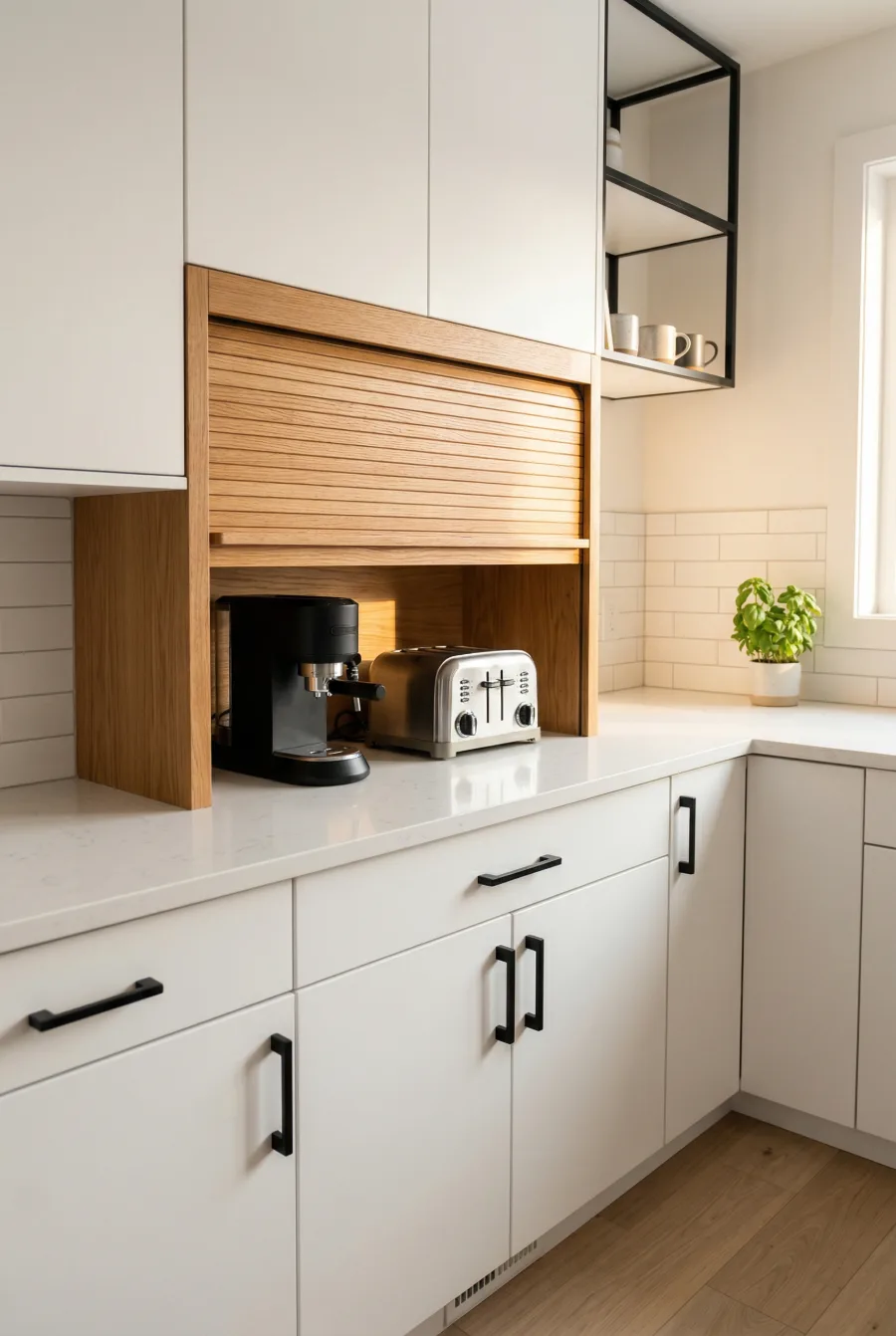
The appliance garage represents the most complete solution to small kitchen counter clutter — rather than organizing the appliances on the counter surface, it eliminates them from the counter entirely by housing them in a concealed cabinet section with a roll-up or hinged door. Open the door and the coffee maker, the toaster, and the kettle are all there, plugged in and ready to use. Close the door and the entire counter appears completely clear — as clean and open as a kitchen in a design magazine. For small apartments where the kitchen is visible from the living area, this visual transformation is significant. An appliance garage doesn’t necessarily require renovation — freestanding appliance garage units are available that sit on the counter and provide the concealment function without any cabinet modification. The best freestanding versions have a tambour roll-up door mechanism that lifts vertically and retracts into the cabinet ceiling, leaving the interior fully open when in use. The cabinet should be deep enough to accommodate your largest appliance in its full position — measure the coffee maker or toaster height and depth before purchasing to ensure the items fit with the door closed. An outlet inside the appliance garage allows appliances to remain plugged in when stored, eliminating the reconnection step each time they are used.